
Vacuum
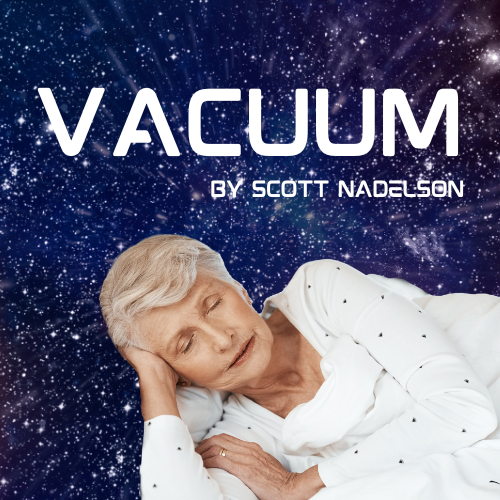
Eight months after her husband died, her son bought her a freeze dryer. It was the kind of gift Ed would have considered frivolous and extravagant, and he would have complained about how much room the contraption took up in the basement. But their son David, who worked in finance, had money to burn, and since he’d bought her a new stacked washer-dryer that fit in an upstairs closet, the basement hardly got any use. Plus, now that Ed was gone, she didn’t know what to do with all the fruit ripening in the yard they’d planted forty years ago: apples and plums and Bartlett pears, all of which would fall and rot if she didn’t preserve them.
“This is better than canning,” David said. “You don’t have to add any sugar. And as long as you keep desiccant packs in the jars, they can sit on the shelf for twenty-five years.”
She was already seventy-seven and didn’t expect to be around another twenty-five years, or even another ten, nor did she know who would eat all the freeze-dried fruit. But David set the machine up for her, describing how it worked—“it creates the same vacuum as deep space in there,” he said, showing her the inner compartment sealed with plexiglass two inches thick—and running it through its first batch over the course of two days. She found the texture of the plum slices after they came out a little mealy, but when she reconstituted them and put them in her cereal, they were flavorful enough. She thanked her boy—forty-nine now and mostly bald, with dark circles under his eyes—and told him to bring the kids soon so they could help her eat the apples and pears. But then she remembered that the kids were both heading back to college now and wouldn’t be home until Thanksgiving. David went through the instructions for the freeze dryer with her three times, making her repeat the steps back to him as if she were a child.
Gathering the fruit from her trees did provide some distraction, for which she was grateful. At first she picked only what she could easily reach from the ground, but when she finished that and the afternoon still stretched ahead of her, she went into the garage and found Ed’s stepladder, along with the picking pole he used before his hips went out. She filled three full baskets with Italian prunes and French petites, along with the first of the Liberty apples and the Bartletts that would need to sit on the counter to ripen. Then a whole evening of coring and slicing, preparing trays, and pressing buttons as David had demonstrated to get the dryer cooling. It would go down to minus fifty degrees, he said, and then you put the fruit in and close the valve. Press the button again, and the vacuum pump would start, removing all the pressure from the chamber. Once begun, it would take about twenty-four hours to finish, so there was no point in watching it, though she still came down to the basement a few times—careful to hold the railing—and peered through the thick plexi window.
She kept thinking how strange it was that inside a box in her own house was a vacuum equivalent to that of deep space. She tried to imagine what it was like for the air pressure to ease until it was gone altogether, the water the fruit slices carried inside slipping away until they were empty of all that once made them part of something living. Over the years she and Ed had watched the occasional documentary about the cosmos—one narrated by Carl Sagan, an updated version by Neil deGrasse Tyson—but the scope of the universe had always remained inconceivable to her, as well as the impossibility of vast spaces between the stars, where so little matter existed there was nothing to hold it together. It was easier to imagine a black hole, so dense it pulled everything toward it and wouldn’t let even light escape. To compare grief to a black hole was a cliché, she knew—she who’d once taught high school English—but it wasn’t quite apt; it didn’t capture the mysterious floating feeling she’d experienced since the funeral, the sense of weightlessness, as if the slightest breeze could blow her over or whisk her away. In deep space there would be no risk of a breeze, though, and she’d just hang there, suspended between nothing and nothing.
The machine was still running when she went to bed. She could hear the pump rumbling through the bedroom floor. Not exactly a comforting sound, but not unpleasant either. A presence in any case, less intrusive than the steady snoring she’d put up with for more than fifty years and more welcome than the silence she’d suffered through the last eight months. She found herself nodding off more easily than she had in some time, and before sleep overtook her, once more she was grateful to David, who hadn’t always been an attentive son—or father—but who was now trying to make up for what she’d complained about only to Ed as years of selfishness.
In her dream she saw him as the lonely boy he’d been at fourteen, fifteen—small and shy, teeth still crooked after a few months of braces, acne sprouting across his forehead—when he was suddenly consumed by a fierce determination to turn things around, wrestle life under his control. He started running obsessively during his junior year of high school, outside as long as it wasn’t raining too hard, on a treadmill in the basement if it was. He adopted a new gregarious persona, a bit clownish but with enough confidence to win people over. And then when he got to college, it was all about balancing parties with maneuvers to position himself for a career and future earnings. He was always prouder of his successes—promotions, raises, bonuses—than she, who often wished he would set aside his ambitions in order to spend more time with those he loved. Now, when she woke in the middle of the night as usual, it was with a feeling of regret at not always remembering what had driven him so intensely as a young man, haunted by the sad scrawny boy he’d once been.
But she didn’t indulge the thought for long. Because now she felt unusually cold under the light blanket she’d been sleeping under all summer. It was still late August, and the temperature wasn’t supposed to drop much below sixty before dawn. But she shivered and pulled the blanket around her shoulders. This didn’t warm her any further, nor did it now feel as if the blanket was around her at all. The room was dark, which was how she preferred it, though Ed had kept a night light plugged into the outlet near the door, so he could find his way to the bathroom at night. It was one of the first things she’d gotten rid of after he died. She’d yanked the alarm clock, too, with its glowing red numbers. She didn’t want to know what time it was when she woke, and there was nothing she needed to be up for, though usually her eyes opened by six anyway. She kept the curtains closed in case she was still dozing when the sun came up.
But this dark was different than the normal sort. The light on the neighbor’s garage must have gone out, she decided, though a part of her already knew better. There was no light of any kind—not from the streetlamp two houses down, not from the moon, which had been nearing its halfway point last night—except perhaps some faint pinpricks in the distance. Her breath came easily, her thoughts strangely buoyant. She hadn’t wanted to admit how much weight she’d felt lifting from her when Ed finally let go, only then recognizing the pressure that had built up through his long decline and final illness, the heft of wishing for it all to be over. It was still rising off her, slowly evaporating day by day, and maybe now it was leaving for good.
She pictured the freeze dryer in the basement, as squat and sturdy as a small refrigerator, the valve on the back she suspected she hadn’t closed all the way. On purpose? She couldn’t be sure. But she had no doubt that what was supposed to happen inside the chamber was happening in the entire house. She’d filled the frame with empty space, or sucked out everything that had once been here. There was no blanket any longer, or a bed, or walls, and her eyes had adjusted enough to recognize the lights in the distance as stars impossibly far apart. Equally far was her impatience with a husband’s dying and a son’s childhood humiliation, too small to really see. Taken in from such a distance what remained visible instead looked more benevolent—a life lived as well as could be expected, full of care often offered and sometimes received, occasionally returned with gratitude.
She was floating now, and there was nothing outside to contain her. She had no choice but to let everything inside slowly seep to the surface and drift away. All mistakes, all losses, all remorse, everything that had burdened her leached out until she was reduced to her essence: what she’d sprouted and cultivated and harvested, so dry it might keep forever.

Scott Nadelson is the author of nine books, most recently the novel Trust Me, winner of the Edward Lewis Wallant Award for Jewish fiction.