
Wolfram the Wolf Boy, 1887
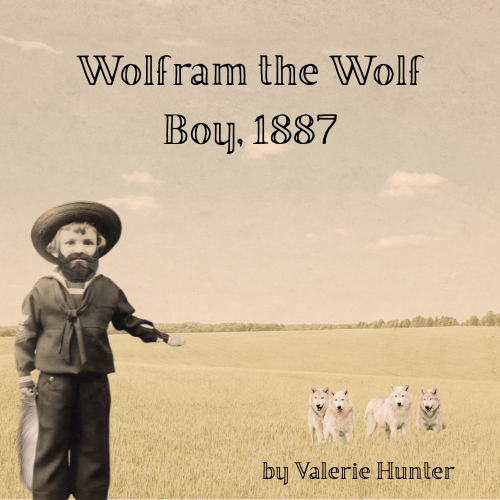
Wolfie is the youngest member of the human menagerie, and there is a lot he doesn’t know about himself. He doesn’t know his exact age, but nine is a nice number. He’s been saying he’s nine for over a year now because ten doesn’t sound quite right. Maybe someday it will.
He doesn’t know why he’s so hairy, either; it’s just the way he is. Brice, the barker in the menagerie tent, says Wolfie is lucky because without the fur he’d still be stuck in the orphanage instead of touring the west with Dr. Faulk’s Traveling Wonder Show. This is true enough, but if he wasn’t covered in fur, wasn’t a wonder, maybe someone without a carnival might have wanted him. Maybe he wouldn’t even have been left at the orphanage to begin with.
In the menagerie tent they’re all part real, part lies. Wolfie’s fur may be real but his tail is a lie, pinned to the back of his short trousers. Brice says the tail came from a real wolf, but Wolfie doesn’t like to think about that. If it was his own tail, flesh and blood, he could wag it, but instead it hangs limp and sad. It has a peculiar smell, too, wilder than Wolfie could ever pretend to be.
The story Brice tells about him to the crowds in the menagerie tent is also a lie: how he was raised in a pack, ran free on the prairie, can’t ever be fully tamed. Normally this is Wolfie’s cue to howl, but there is a girl at the front of the crowd today, a girl just his size, and he smiles at her instead. She doesn’t smile back, just stares, wide-eyed, and keeps staring even as Brice moves on to introduce Seth the Slug.
After this crowd clears out, Brice grabs Wolfie and twists his arm. “Wolves don’t smile! You’re a ferocious beast and don’t forget it!”
Wolfie’s arm stings, but he doesn’t let himself cry. Wolves probably don’t do that, either.
When the next crowd comes in, he’s ready. He glares and frowns, and when Brice finishes his spiel, Wolfie howls for all he’s worth, even throwing in a ferocious snarl. For once he is as wild as his tail.
A small boy and girl cry at the sight of him, burying their faces in their mother’s skirt. Wolfie can hear her murmur, “There, there, it’s not real,” but the children keep sobbing anyway. He is a monster to haunt their nightmares, a real/ not real thing. Afterwards Brice tells him to tone it down. There’s no pleasing Brice.
That night Wolfie has a nightmare of his own. He wakes with a start and a shudder, the fur around his eyes damp. He sits there in the dark of the sleeping tent, curled up in his blankets between Seth and Horace, and the worst part isn’t the fear that jitters through him, slithery and cold, but rather that he can’t remember what the dream was about. There’s only a dark void in his head where the memory should be, and he’s left to fill in the blank, to wonder if maybe he dreamed of himself, if maybe he really is terrifying and that’s just one more thing about himself he doesn’t know.
He slips out of the tent, stares at the moonlit prairie. On the horizon he swears he sees two wolves running. Seth told him there aren’t many wolves left around these parts; hunters have seen to that. Is this the ghost of his pack, his family?
He imagines running after them, running with them, but he knows they wouldn’t want the likes of him any more than a human family would. He is not wolfly enough, not ghostly enough. He is not enough of anything.
He goes back in the tent and returns to his nest of blankets, burying his face in one for a moment and then taking it away. He doesn’t need a mother’s skirt to cry in. He is a wild wolf and he is a boy; he is real and not a nightmare. Tomorrow, he decides, he will be ten.
Valerie Hunter teaches high school English and has an MFA in writing for children and young adults from Vermont College of Fine Arts. She writes in an attempt to make sense of the world.