
Where the Ink Ran Dry
The air in the kura, the old storehouse, was thick with the scents of camphor and time. Yuki pried open the lid of a long, black lacquer chest, sending dust motes swirling in the single beam of Kaoru’s flashlight. “Careful, Kaoru,” Yuki said, her voice soft in the stillness. “This belonged to your great-grandmother.”
Kaoru knelt beside her, tracing the inlaid mother-of-pearl cranes on the chest. “She was a ghost to me. Just a name on the family tree.” She felt like a ghost herself sometimes, walking through the old family home they were now restoring. A woman with a name her family hadn’t given her, loving another woman in a house built on the silent, straight lines of succession.
Beneath layers of brittle silk kimonos, they found it. Not a diary, but a suzuribako—a writing box, exquisite with dark carvings. Inside, nestled beside a petrified inkstone and a delicate brush, were scrolls of practice paper, covered in elegant, flowing calligraphy.
“Just practice strokes,” Kaoru murmured, her trained eye recognizing the repetitive characters. She was a calligrapher herself; it was how she’d found her center. But as she unrolled the last, slender scroll, the writing changed. It was smaller, more urgent, squeezed into the margins.
“What is it?” Yuki leaned in, her arm warm against Kaoru’s.
Kaoru’s breath caught. The language was archaic, but the feeling was achingly familiar. She read aloud, her voice a whisper.
Autumn, eighteenth year of Meiji. Father insists I practice the characters for ‘duty’ and ‘son.’ He calls me Kenshin. He praises my strong wrist. My wrist is strong from binding my chest each morning until I cannot breathe. The ink bleeds on the paper, but it is my own name I want to write. Aoi. Only she calls me Aoi.
Yuki found Kaoru’s fingers and squeezed. Kaoru kept reading, her heart a drum against her ribs.
Winter. The snow is deep. We met behind the shrine, our breath misting as one. She is to be married in the spring to a man from Tokyo. Her father’s choice. Last night, in the quiet of the tea room, she traced the line of my jaw and said, ‘There is more honor in this face than in all the samurai of the domain.’ Her name is Shiori. They see her as a prize, a perfect doll for display. They do not see the fire in her, the one that keeps me warm.
They read of stolen moments over the Go board, of poems exchanged on folded paper, of a love that lived in the silent spaces between formal bows and sliding paper screens. Aoi wrote of the agony of her body—a vessel she didn’t recognize—and the brief, blinding euphoria of being seen, truly seen, by Shiori.
Then, the final entry. The ink was chaotic, smeared, the brush strokes dashed and broken.
First day of the new moon. He found my poems. Shiori’s father. He does not see poetry, only filth. Sickness. He burned them in the brazier. He called her name a curse and mine…he called me a fox spirit, a monster deceiving a good family. Shiori is now confined to her room. Tomorrow, they send me away to a monastery. They will say Kenshin sought enlightenment. They will erase Aoi. They will erase us. But I hide this one scroll. I write this in the dark. So that someone, someday, will know. We were real. My name is Aoi. Her name is Sh—
The ink trailed off into a desperate, final stroke, a character left unformed. A life, a love, silenced mid-syllable.
Kaoru gently rolled the scroll, her hands trembling. The silence in the kura was immense, filled with the ghosts of two women she had never known, but whose story was etched into her soul. “They just…stopped,” she whispered, a tear falling onto the dusty floorboards. “They were scraped away.”
Yuki took the scroll from her, holding it as if it were a fragile, sleeping bird. She looked at Kaoru, her eyes deep and certain in the gloom.
“The ink ran dry, Kaoru, but their story didn’t end.” She gestured to the empty space on the far wall of the storehouse, where a new beam of light from the main house now fell. “That scroll isn’t an ending. It’s a foundation stone.”
Yuki’s voice grew stronger, ringing with a fierce tenderness. “You know kintsugi? The art of repairing broken pottery with gold? Some people think it’s about fixing what’s broken. But it’s not. It’s about honoring the history of the break. The damage is part of its beauty now.”
She held the scroll up. “They were broken apart—erased—but they left a crack in history.” She then took Kaoru’s hand, her thumb stroking her knuckles. “And we, my love, we’re the gold. We fill the space they left behind. Not to hide the break, but to make it shine.”
Kaoru looked from the ancient, unfinished story to Yuki’s face, so full of love. She thought of the life they were building here, nail by nail, meal by meal, kiss by kiss. A future not of ghosts, but of warm hands and shared beds and two names, spoken aloud, in the light. They would hang the scroll in their home, not to commemorate a tragedy, but as a promise. The first character in a story they would finish themselves.
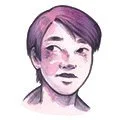
Toshiya Kamei (she/they) takes inspiration from fairy tales, folklore, and mythology. She attempts to reimagine the past, present, and future while shifting between various perspectives and points of view. Many of her characters are outsiders living on the margins of society. For more information, visit https://toshiyakamei.wordpress.com/.