
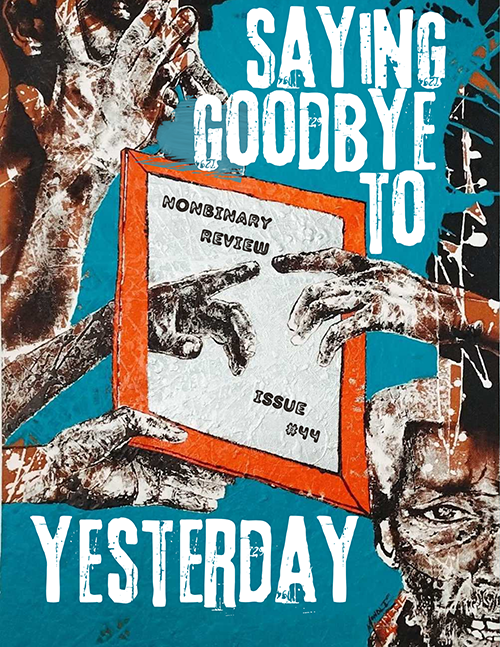
Issue #44: Saying
Issue #44: Saying
Goodbye to Yesterday

D. Arifah
Drive Away
D. is a photographer from Indonesia who is captivated by the silent stories the world tells. Much of her work is an invitation to pause, listen, and see the world around us with greater intimacy.

Christian Barragan
In Good Order
Christian is currently an MFA candidate at Hollins University. His work has appeared in the Raven Review, Takahē Magazine, and Open: Journal of Arts & Letters, among others.
-
Do you use a pseudonym? Why or why not?
I don’t use a pseudonym. I briefly considered using one when I started writing flash fiction eight years ago, but decided against it when I couldn’t think of anything that would sound cool forever. I want my stories to be easy for people to find, so it’s probably too late to start now.What is the most confusing thing anyone has said to you about your work?
There was a short story I wrote in the form of a pseudo-essay telling someone how to submit to literary magazines. In their rejection letter, one magazine said it sounded like a “reverse-psychology plea for publication.”What writers/artists/filmmakers//musicians have influenced your work - either the work itself, or the way in which you work?
I draw a lot of inspiration from the works of Philip K. Dick and Kazuo Ishiguro, especially for my science fiction stories.Is there one part of your creation process that’s harder for you?
The hardest part for me is probably the sentence level. I tend to write the first draft quickly to get everything on the page before I forget, so it takes a lot of editing for it to not sound too mechanical afterwards.How do you handle rejection? Do you have any advice for other creators about handling rejection?
At this point, I think I take rejection well. I make enough submissions so that I get a rejection every other day or so. At this point, I feel nothing. The best advice I could give is to find some magazines you think would be interested in your work, send your work out to all of them, and then keep doing it. It’ll make the rejections feel less personal than if you submitted to one at a time. Just accept that the rejections are part of the process, and a lot of them really just amount to individual preferences.Do you have a piece that you created early in your career that makes you cringe? Will you ever go back and fix it so it can be submitted somewhere?
There was one piece I wrote at the end of 2019 that I considered my best at the time. I spent at least a year submitting it before I realized it was way too abstract for me to edit without completely changing the story. Everything in there was a metaphor so there wasn’t much for a reader to cling onto. As the writer, I didn’t have an entrypoint to improve it so it ended up scrapped. I doubt I’ll come back to it, but I’ve learned to accept that some pieces just won’t end up working out.What is your biggest creative doubt?
I always ask myself “is this piece saying enough?” I think of each story as part of a conversation with the reader, whether or not I know who that is, so I always wonder if I’m expressing as much as I could be. Some stories end up a lot more personal than others, and those are the ones I’m generally most proud of. I hide the personal elements in layers of genre conventions, so they usually aren’t immediately obvious except to people who know me very well.Is there a deep, dark secret you’re carrying? If so, why are you keeping it? (No, we don’t want to know what it is. We love a mystery.)
Yes, there are a few. I don’t keep too many secrets anymore, but I keep a few just to remind myself that I still can.

Leslie Brown
Lone signal
Leslie’s recent visual art has been published in Quibble, Closed eye open, NonBinary Review Issue #33: World Tour, Phoebe Literary Journal, Beyond Words, Scapegoat Review, ZO magazine, and Burningword literary journal.
[sarah] Cavar
have you heard the one where Hashem &I walk onto a narrow bridge and wrestle with plurality
[sarah] is the author of Failure to Comply (featherproof books, 2024) and Differential Diagnosis (Northwestern UP, 2026). They edit manywor(l)ds.place, and have been published in Electric Lit, The Rumpus, The Offing, and elsewhere.
Kiera Conrad
Reaching Through the Wind
Kiera is a writer and anthropologist who splits her time between Boston, USA and Cork, Ireland.
Madi Corell
You still haven’t called to ask when I’m coming home
Madi is a are a current MFA candidate at N.C. State University in Raleigh, North Carolina. You may find their poetry at Silly Goose Press and the Screen Door Review.
-
What writers/artists/filmmakers//musicians have influenced your work - either the work itself, or the way in which you work?
Jericho Brown is one poet who has been incredibly influential in the way I understand and work with form. I was introduced to Jericho Brown’s “Duplex” a few years back and haven’t stopped obsessing with the ways in which form can work with heart to create a really honest poem. I also watched his “Form and Process” interview with The Missouri Review where he talks about using each line as an opportunity for surprise. Often when I feel stuck, I use this method to generate lines that surprise me. Even if form or volta don’t make the poem, they almost always start the poem for me.Is there one part of your creation process that’s harder for you?
I love to let my writing surprise me, but sometimes it can be hard to get to the surprise. If I get stuck, it is usually when I have a bunch of images or lines, and I have tried a dozen forms or approaches and can’t quite get to a poem I’m excited about. Sometimes, it just takes a while to get to the surprise. Sometimes, I find I may not like a poem at first, but I bring it to a friend, and they show me a way to revise that gets me reinvested in the poem. I’m learning to enjoy and make time for playing around in this way without expecting a poem at the end of it.How do you handle rejection? Do you have any advice for other creators about handling rejection?
One way to handle rejection, and this is what I’ve been encouraged to do, is to dive headfirst into it and let yourself get rejected so much that it doesn’t sting quite as much. This approach seems to work to an extent. It also is important to feed your writing life in other ways, so acceptance or external validation isn’t what keeps you writing. I guess another way to put this is to remember why you love writing. For me, this can look like doing poetry readings, exchanging poems with a friend, or even creating art based on my work. These are ways outside of publishing that help me celebrate the work and connect with people who are also engaged in a similar practice.Do you have a piece that you created early in your career that makes you cringe? Will you ever go back and fix it so it can be submitted somewhere?
I have plenty of cringy work from the distant and more recent past. I like to keep it tucked away in a folder, and sometimes I look back at it to remember that creating cringey work is part of the process. Occasionally, I’ll pull images or words from these poems to repurpose in a newer poem. I may go back and revise these works someday, but right now my plate is full with creating new work. I’m not throwing work away, but it’s helpful for me to keep a loose grip on poems. Some poems are just for me to learn, experiment, or express, and I think that’s okay.What is your biggest creative doubt?
Frequently, I am worried that I will never create an exciting or moving poem again, though this is a fear I’m getting used to. The more I write, the more I gain appreciation for the process, and I’m less worried about the end result. Also, I’ve proven this fear of mine wrong. Inevitably, if I am writing, I will surprise myself eventually. A similar doubt or concern I have is that my writing will feel more like work than the creative and spiritual practice I started with. Similar to handling rejection, I find it helpful to find gentle and fun ways to engage with the work that remind me why I started writing. Usually, that is just a conversation with a fellow poet.What piece of creative advice have you received that sounded good, but was ultimately not useful to you?
Any rules for how a poem should look or sound. I have heard people talk about rhyme as something to fear. I think this advice comes from instructors working with newer poets. Newer poets often imitate older poets and their rhyme schemes, but I would encourage people to analyze why they’re drawn to rhyme and LEAN IN. As someone who is very interested in sonics and rhyme, I find it more helpful to ask: how can I use rhyme in a way that is surprising? How can the placement change the understanding of the piece? I find reflection and analysis to be more helpful tools than specific rules.
Caden Crane
Tuesdays, Am I Right?
Caden is a UK-based writer desperate for escape, whether that means through fiction or an airplane, he’s not picky. He spends his days as most writers do; that is to say thinking about writing, rather than actually doing it.
Deborah Davitt
When We Cannot Let Go
Deborah’s award-winning poetry and prose have appeared in over seventy journals, including F&SF, Analog, and Lightspeed. For more about her work, please see www.deborahldavitt.com.
Cailín Frankland
Ben Síde
Cailín is a British-American writer and public health professional based in Baltimore, Maryland. They live with their spouse, two old lady cats, a rotating cast of foster animals, and a 70-pound pitbull affectionately known as Baby.
-
Do you use a pseudonym? Why or why not?
No and yes. The vast majority of my published work is under my own name (and promoted under my Twitter/X handle @cailin_sm), but I have in the past shared autobiographical work under a pseudonym/anonymously in the interest of protecting my safety and privacy.What is the most confusing thing anyone has said to you about your work?
"I'm not even sure that I believe that the twist works from a literary perspective, but you have managed to genuinely surprise me, to even shock me, and that is rare in a story." Certainly the most confusing acceptance I have ever received! You can read the piece, "Fisheye Lens", here.What works do you feel have been left out of the western literary canon - works from other countries, in other languages, or by marginalized people?
Works in languages other than English and by authors not based in the Global North are certainly underrepresented in the western literary canon, as are works by trans and genderqueer authors, Indigenous authors, immigrant authors, working class authors, disabled authors, and authors living at the intersection of multiple axes of oppression. The western literary community has a tendency to view "representation" as the act of platforming authors who have lived experience with a specific marginalised identity but hold other forms of privilege, rather than truly making space for voices from the global majority; to me, this feels less like true inclusion and more like tokenism. I would love to see the publishing industry become more accessible to all writers, and to see the western literary canon expand to respect and celebrate a greater breadth of human experience.What writers/artists/filmmakers/musicians have influenced your work - either the work itself, or the way in which you work?
The list of authors, filmmakers, and artists who have influenced my work is constantly growing. As a horror aficionado, I tend to gravitate towards emotionally disquieting works that convey potent political commentary; I strongly believe that the creation and distribution of art is an inherently political act, and greatly admire the artists of the past and present who have leveraged their skills to inspire and provoke social reckonings. Some of my favourite authors include Octavia Butler, Akwaeke Emezi, Mona Awad, T. Kingfisher, and Gretchen Felker-Martin, and I draw inspiration from television shows like Black Mirror and Yellowjackets and films like Us, Parasite, and The Substance. I even wrote an essay on The Substance, "To Fear The Substance is to Fear Ourselves", which you can read here.Is there one part of your creation process that’s harder for you?
As someone with a tendency to overplan, I sometimes find myself panicking when a piece I am writing starts going in a direction I didn't anticipate. In those moments, I try not to get too attached to my initial vision of what I expected a story, poem, or essay to become and to let my instincts guide me in the most promising direction.How do you handle rejection? Do you have any advice for other creators about handling rejection?
Exposure therapy! My fear of rejection held me back from pursuing my passion for writing for years, and facing that fear head-on has been one of the most gratifying experiences for me as an author. I like to view rejection as redirection, and greatly appreciate the publishers who take the time to offer constructive feedback should they choose not to publish my work. My advice for other creators facing the harsh selectivity of this industry is to maintain your belief in the quality of your work and value of your voice; the path to publication is paved with rejection letters!Do you have a piece that you created early in your career that makes you cringe? Will you ever go back and fix it so it can be submitted somewhere?
Most of the early work I am embarrassed to revisit remains mercifully unpublished, but I often draw on it for inspiration.What is your biggest creative doubt?
In my less confident moments, I find myself fearing that I have nothing interesting to say through my work - that every idea worth exploring has already been written about by someone with a sharper pen than my own, and that anything I produce is therefore a pale imitation of my more talented literary ancestors and contemporaries. Receiving positive feedback from editors and readers has largely helped to quell my self-doubt, but I never want to lose my fear of mediocrity entirely; it inspires me to continue innovating and improving my work.What piece of creative advice have you received that sounded good, but was ultimately not useful to you?
Most writing advice involves some equivalent of telling authors to plan out or roadmap their stories before they begin drafting. While I am sure that this is great guidance for many writers, I find that I produce my best work when I don't overplan the contours of a piece I'm working on and instead let it take shape naturally as I write.Is there a deep, dark secret you’re carrying? If so, why are you keeping it? (No, we don’t want to know what it is. We love a mystery.)
Yes, but it's not that deep, and it's not dark at all. In fact, it won't even be a secret for much longer. ;)
Judi Mae "JM" Huck
Jisatsu: After Reading the Execution of an Archvillain
JM is an MFA candidate at the University of Nevada-Las Vegas whose scholarly interests include Southeast Asian epic traditions.

Pravy Jha
When the City Decided to Archive Us
Pravy is a student writer from India. Her work has appeared or is forthcoming in Brilliant Flash Fiction, Last Syllable Literary Journal, Blue Marble Review, and anthologies such as Upon Learning That and Rooted In: Rite.
-
Do you use a pseudonym? Why or why not?
No, I use my own name. It feels important to me that the work and I stay in conversation with each other. I think I’m still figuring out what it means to write under something that already holds so much before I even begin.What is the most confusing thing anyone has said to you about your work?
Someone once told me my work felt “too quiet to be urgent.” I remember not knowing how to respond to that. I’ve always felt that quietness can carry its own kind of urgency, just not the kind that announces itself immediately.What works do you feel have been left out of the western literary canon?
A lot of work that comes from oral traditions or from communities where storytelling isn’t always preserved in institutional ways. I think there are entire bodies of writing that exist in fragments, in memory, in translation, and those often get overlooked because they don’t arrive in a form the canon recognizes as complete.What writers/artists/filmmakers/musicians have influenced your work?
I find myself returning to writers like Rumi and Khalil Gibran for their sense of inwardness, and to novelists like Jane Austen and Khaled Hosseini for how they hold emotional tension over time. I’m also influenced by films, sometimes more than I realize, especially in how they handle silence, pacing, and what they choose not to explain.Is there one part of your creation process that’s harder for you?
Letting a piece be finished. I don’t struggle to begin, but I find it difficult to stop adjusting the tone, the rhythm, the spacing. There’s always a sense that the poem could still shift slightly and become something else.How do you handle rejection? Do you have any advice for other creators about handling rejection?
I’ve stopped trying to take rejection personally, which is easier said than done. Most of the time it’s not about the work being “bad,” it’s about fit, timing, or what the editors are drawn to in that moment. My only real advice is to keep the work moving. Don’t let one decision determine where a piece gets to go next.Do you have a piece that you created early in your career that makes you cringe? Will you ever go back and fix it?
Yes, definitely. But I don’t think I would go back and fix it. It belongs to a version of me who was still figuring things out, and I’d rather let it stay there than try to rewrite it with what I know now.What is your biggest creative doubt?
That I might be circling the same questions without actually moving closer to anything new. But at the same time, I’m starting to think that returning to the same questions might be the work.What piece of creative advice have you received that sounded good, but was ultimately not useful to you?
“Write what you know” never fully made sense to me. A lot of what I’m interested in writing about is only partially known, or felt before it’s understood. If I only stayed within what I already knew, I think the work would become too contained.Is there a deep, dark secret you’re carrying? If so, why are you keeping it?
I wouldn’t call it a secret, more like something I’m still figuring out. I’d rather sit with it than rush to define it too quickly.
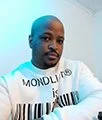
Mondli Kunene
Wisdom Is Learnt From the Elders, cover
Mondli creates African art using acrylic on Masonite with leather and warthog tusks to address social issues. Awards include film prizes, Forty Under 40; international exhibitions; mentors youth, establishing art hub. See his Instagram: @mondliart

E.J. LeRoy
Momo’s Kite
E.J. is a Pushcart Prize nominated writer with credits in several publications including The Lorelei Signal, Neon & Smoke, and Tales from the Crosstimbers. LeRoy also has a novella published by The Whumpy Printing Press.
-
What is the most confusing thing anyone has said to you about your work?
It is often confusing to me when I receive rejections that say something along the lines of, “This is interesting, but it is more of a vignette than a story.” This is especially puzzling when the submission is a flash or micro fic! To me, a story, regardless of length, doesn’t need to follow a traditional three-act structure to be considered a real story. Slice of life accounts are just as valid and worthwhile as epics with a clear hero’s journey.Interestingly, several of my old trunk stories with “vignette” rejection comments have been purchased in the past couple of years. These stories haven’t undergone any significant revisions. Instead, it seems that more and more literary magazines are open to character snapshots and experimental pieces. Meanwhile, children’s literature appears to have gone in the other direction where everything has to have a “point” or a gently woven-in message. Whether written for a juvenile or adult audience, character-focused stories should be allowed to exist for their own sake alongside more traditional storytelling styles.
What works do you feel have been left out of the western literary canon - works from other countries, in other languages, or by marginalized people?
Who gets to decide what constitutes Western literary canon? I’ve often joked that the so-called classics haven’t actually withstood the test of time as claimed; a good deal of them probably only remain in print because English teachers keep ramming them down their students’ throats.On a more serious note, fiction and nonfiction accounts about peacemakers and conscientious objectors remain woefully underrepresented among must-read and must-watch lists. Of course, there are many wonderful biographies and biopics of famous Civil Rights leaders, but where are the thrilling accounts of World War I conscientious objector Ben Salmon, or the first U.S. congresswoman and peace activist Jeanette Rankin, or the relentless civil disobedience of Fr. Daniel Berrigan? Sadly, serious examinations of peace and its advocates continue to remain in the margins rather than front and center.
What writers/artists/filmmakers//musicians have influenced your work - either the work itself, or the way in which you work?
I like to think that I have my own writing style but have been greatly aided by Strunk and White’s The Elements of Style when it comes to the mechanics of good writing. Elmore Leonard’s 10 Rules of Writing is another excellent resource that is also a lot of fun.How do you handle rejection? Do you have any advice for other creators about handling rejection?
Years ago, I read an online article by Kim Liao encouraging authors to aim for 100 rejections per year. In short, it is helpful to think of each rejection as being a measure of productivity rather than failure. It also requires a degree of courage to submit work, knowing that a rejection is statistically likely and, yes, may hurt. But the more you submit, the more likely you are to have your work accepted eventually.My advice for creators regarding rejections is manifold. First, make sure your story fits all the guidelines of your target market. Sending something that doesn’t fit the guidelines is the worst and easiest way to get a rejection. If it doesn’t fit, either send a different story or create a modified version of the same story to make it fit, assuming any necessary alterations don’t interfere with your core vision. Always keep your original story version as a template!
Second, persevere. If your work is rejected, immediately send it somewhere else. Just because that piece was rejected doesn’t mean it was bad. Or maybe it was bad, but so what? At least you gathered the nerve to submit it in the first place. I’m not saying to bombard editors with rough drafts (please don’t), but you may not want to self-reject just because a piece is experimental.
Third, even if a piece is rejected with critical feedback, you don’t necessarily have to believe it. Sure, if the editor’s advice makes sense, go ahead and fix any problems before sending it elsewhere. In general, though, I’ve found that a lot of rejections come down to a particular editor’s taste. I’ve had several pieces get rejected because they are, “too slice of life,” “didn’t have enough story and depth,” or had “muted conflict.” These are actual rejection quotes in my records, and every one of those stories got accepted by other markets without alterations.
Fourth, make a game of writing down acceptances and rejections. It’s fun to look back at the statistics when you’re victorious. In 2025, I recorded 819 rejections and 45 acceptances. That’s a record in both columns, a great sign of my writing productivity. Although it could also be a sign that I need to get out more…
Is there a deep, dark secret you’re carrying? If so, why are you keeping it? (No, we don’t want to know what it is. We love a mystery.)
What, you mean other than being an author who writes under a pen name? :-)
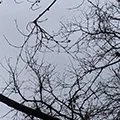
Sasha Levin
Unfinished Farewell
Sasha is a poet, forager, and cat lover learning to breathe again with Long Covid. They believe a better world is possible, and that together we can write it.
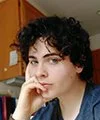
Evie Maher
Angel of Sorrow
Evie is a freelance artist from San Diego, California who works in traditional and digital media. Their primary medium is pen and watercolor and they have been exhibited in several museums and galleries across San Diego County.
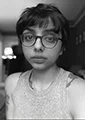
K. Meera
Burr Holes
K.’s work has appeared in Speculative Fiction Between Stars and Clay, Strange Horizons and is upcoming in Mythaxis Magazine. They write about tamil-paasam, queerness, and the constructions of impossibility.
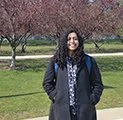
Rajvi Mittal
Girl With Memories Packed
Rajvi is a photographer, writer, and creator from India. Rajvi regularly writes on Medium and has self-published a poetry book, Reborn: Darkness is the Seed of Light.
-
Do you use a pseudonym? Why or why not?
Nope. Well, atleast, not yet. Currently, my top priority is to give my inner child the experience of being celebrated publicly and have the freedom to yap about my works without any reservation. So right now, all my works bear my name proudly.In the future, however, when I (hopefully) become recklessly famous for hellish-dark poetry or a bold spicy book series, I would love to be able to turn off the spotlight & be a nobody. Then I'd embody my inner Marshmello & have a ball.
What works do you feel have been left out of the western literary canon - works from other countries, in other languages, or by marginalized people?
India has the second largest english speaking population in the world - and yet there are only a handful of literary magazines born from India. While literature & language belong to no one and everyone, the resources and ecosystem to pursue them have been concentrated inside america. I am unsure of the reason - maybe there is malicious intent, maybe the reason its as simple as nobody noticed ? In any case, I hope to see more literary publications, presses and magazines emerging from India, and other parts of the world.Beyond language, I hope to see other limitations dissolve - for example ideas of people who haven't had a traditional MFA or literary edication - but see the world in a unique way, which could add to everybody's knowledge if there was a system to teach them literary skills. In that sense - I want to read poems written by scientists, indulge in paintings made by accountants, visit exhibitions of abstract design made by janitors, listen to music composed by people who don’t know what a smartphone is - I want it all. I want the literary world to not be an exclusive club but a leader in effecting a global kinship. I want the literary world to commit to art's power of dissolving boundaries and making people realise just how similar they are to those they consider 'others'.
What writers/artists/filmmakers/musicians have influenced your work - either the work itself, or the way in which you work?
It is absolutely impossible for me to list all of my inspirations & influences, because everyone I meet, every poem I read & every place I visit changes me a little (which makes me think of myself as a mosaic of em all). Still, I'll try:When I was in school, I used to devour mystery novels (Nancy Drew, Secret Seven, Famous Five, Hardy Boys) but the credit for making me a bibliophile goes to Anne Frank's Diary of A Young Girl. We read it as part of our high school curriculum, but it's existential nature ended up making me aware of the 'real world' beyond studies. I believe it instilled in me a deep desire for creating sensitivity & empathy in the world, which I aim to affect through my life & my creative work.
I love music because it helps people express all emotions, transcends the barriers of language, and brings everyone together. Consequently, singers and musicians take up majority of my heart and headspace. I lose my worries listening to Atif Aslam, Adnan Sami, A. R. Rehman, Arijit Singh, Shreya Ghoshal, Vidya Vox, Rihanna, Jennifer Lopez, Shakira, Adele, and Falguni Pathak.
Next, I watch a lot of stand up shows & love the comedians: Iliza Shlesinger, Ali Wong, Michelle Wolf, Whitney Cummings, Daniel Sloss, K-Von, Gianmarco Soresi, Kanan Gill, Biswa Kalyanrath, Zakir Khan, Ravi Gupta, Gurleen Pannu, all of whom have a distinct personality and are excellent storytellers. Having watched comedians from all over the world, I have come to believe in humor's unique power to create empathy by slipping past our defences & placing the seeds of the unfamiliar inside our minds.
Finally, I love stories from Pixar & (recent) Disney including Inside Out, Zootopia, Elemental. Besides having a refreshing, positive message for society, I feel, they are also the finest works in the industry, world-building with consistency & pointed detail.
Is there one part of your creation process that’s harder for you?
Organizing steps, managing time, and following through require a lot of executive functioning that doesn't come easily to me. I would rather create a hundred half-done projects than complete my ongoing ones. For example, currently there are 100+ books on my Read shelf. But, if you add the books I started and finished halfway through, the number would easily be 200+!What piece of creative advice have you received that sounded good, but was ultimately not useful to you?
One of the nastiest pieces of advice I have recieved which looked good on surface was to 'pick a niche', 'become an expert', 'never be the jack of all, master of none'. The only thing this advice accomplished was to make me feel 'too much' and out of place in the creative world.For the longest time I remained confused and awkward about the plethora of my interests, hobbies and creative passions. Fortunately, I stumbled upon the amazing work of Barbara Sher. If you too feel overwhelmed with the multitudes of your passions, I urge you to read her book Refuse to Choose. It might just change everything about your creative mindset.
Is there a deep, dark secret you’re carrying? If so, why are you keeping it? (No, we don’t want to know what it is. We love a mystery.)
Yep! I am looking for the correct moment when the world is ready for it (though it seems less probable it might happen anytime soon).
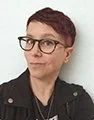
Janine Moore
Mother
Janine currently resides in Portugal but grew up in the United States. In their early fifties, they have more space to look back, reflect, and sublimate past hurt into poetry. It is a freeing process that they highly recommend.
-
Do you use a pseudonym? Why or why not?
I do not use a pseudonym. Mostly, because I feel like all the names I've used have been pseudonyms to one degree or another. My family surname was — as I tend to put it — a lie. It was an anglicized Polish name used to make assimilation in the U.S. easier early last century. My parents treated me on a range of benign to not so benign neglect, so I never felt much attachment to it in any case. Then my surname changed through a couple of marriages leading my name to feel even more ephemeral. Perhaps if I were a man I would care about my name more due to matters of lineage or prestige. Then again, perhaps my true name will be revealed to me in my sixth decade.What works do you feel have been left out of the western literary canon - works from other countries, in other languages, or by marginalized people?
Nearly everything has been left out, to be honest. Sometimes I wonder who I would be now, if I had been assigned to read Audre Lorde in freshman English instead of Ernest Hemingway. The harmful part — and I don't think I'm the only one who feels this way -- is that you are made to feel WRONG if you don't get it. The greatness of the high school English lit curriculum is not presented as opinion or given a context. It's not explained that this is writing deemed worthy by white supremacy and the patriarchy. Of course this was, I'm sure, much more pronounced when I went to public high school in Kentucky in the 80s.Is the whole concept of "canon" flawed? I hope humanity one day interprets the worthiness of art and literature in more expansive terms. Can't it just be that which helps us understand ourselves and others better? Can it be just that which makes us feel? Is that The Old Man and the Sea for most people in 2026? I'm guessing not. (I really hate that book.)
What writers/artists/filmmakers/musicians have influenced your work - either the work itself, or the way in which you work?
Without a doubt, one of the biggest influencers of my work is performance artist, Laurie Anderson. Her critiques of America. The cadence to her speech. Her androgyny. The gender-bending way she manipulates her voice. I found in my artistic home in her my late teens.Also very influential was the New Folk Movement in the 90s, especially Nanci Griffith and John Gorka. My family has working class immigrant roots from southeastern Europe, and what I took from these folk artists is that beauty is easily found in the lives and stories of everyday people.
In graduate school, I encountered bell hooks and Paulo Freire. They taught me that education, literature, and art are liberatory practices. Recently, I stumbled across Marquis Bey, who I adore, and I already feel influencing my current writing. These are all teachers that encourage, nudge, and challenge me to dig into my assumptions and obliterate them for my and everyone else's good.
Finally, there's Uncle Walt. Walt Whitman, our dearest and most famous queer poet in the U.S. Thank goodness he, Ralph Waldo Emerson, and Henry David Thoreau made their appearances in my middle school "gifted child" classes. Transcendentalism taught me to be a critical thinker and question societal norms in a very American, but transgressive way. I find they dance across my thoughts and my pages still.
Is there one part of your creation process that’s harder for you?
Since my poetry goes to some really dark places in my personal history, the hardest part is allowing myself to touch those tender spots. However, as I've belatedly, yet rapidly, discovered, the much harder thing is not to do do.How do you handle rejection? Do you have any advice for other creators about handling rejection?
I've been exploring Buddhist philosophy on and off for a long time, and, frankly, it's very helpful here. Holding things lightly — even (especially?) what is most personal and dear, because everything is impermanent. Not grasping after things, but knowing you already have everything you need in this moment. It's completely antithetical to how most Americans are conditioned to approach life. But in my estimation, much more akin to the true nature of our existence.Also, I write to express myself and as a part of healing past trauma. Sharing what I write and others bearing witness is wonderful but is never my endgame. It's more adjacent to the primary project.
What piece of creative advice have you received that sounded good, but was ultimately not useful to you?
Most creative advice I received when I was young revolved around good form and craft. I think that's very common in high school and university creative writing courses. Today I think the poetry is just "there" in the subconscious, more or less fully formed.If it's not too cliché to say it, The Artist's Way, which I only found recently, was very illuminating. Not in the sense of Julia Cameron's abiding belief in a God or benevolent universal force that wants you to create. That's bollocks. But in the way she guides you to opening up to yourself. The exercises help you understand that unique collection of experiences and memories that are careening around your body and mind that make up what you understand to be you. And that's where the poetry is.
Is there a deep, dark secret you’re carrying? If so, why are you keeping it? (No, we don’t want to know what it is. We love a mystery.)
No. I'm not cool. I'm a queer, middle-aged dork. I'm doing my part to heal intergenerational trauma. My being is resplendent in its particularities, but mostly in its ordinariness.
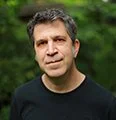
Scott Nadelson
Vacuum
Scott is the author of nine books, most recently the novel Trust Me, winner of the Edward Lewis Wallant Award for Jewish fiction.
-
What works do you feel have been left out of the western literary canon - works from other countries, in other languages, or by marginalized people?
There are so many, and lucky for all of us, the notion of a single canon—both within and outside of academia—has been slowly dissolving into a multitude of canons promoted by a multitude of readers. But I’ll single out one of my favorites, a book that ought to be considered a modern classic and read widely: Arabesques by the Palestinian novelist Anton Shammas. It was first published in English translation in 1988, went out of print for a long time, and was recently reissued by NYRB. A must read literary and political coming-of-age story.What writers/artists/filmmakers//musicians have influenced your work - either the work itself, or the way in which you work?
One of the greatest pleasures of making is being in conversation with other makers, and I’ve been influenced by hundreds. Visual artists have been especially important to my writing practice; so have songwriters. I love the way so many painters, sculptors, performance and video artists center play and process as much as product. Watching one painter friend a few years ago obsessively sketch the same images over and over, in countless variations, was particularly freeing: it allowed me to stop thinking about the big picture and focus instead on the spontaneity of the moment, playing with language, image, character until something surprising happens.Is there one part of your creation process that’s harder for you?
I’m an obsessive tinkerer, so the hardest part for me is coming to an end. The polishing stage is torturous, because that’s when the slipperiness of language becomes most apparent, and every version of a sentence starts to sound wrong. Eventually I just have to get interested enough in a new idea in order to let the old one go.How do you handle rejection? Do you have any advice for other creators about handling rejection?
I wish I could say after doing this for so long rejection no longer bothers me, that I just shrug it off and move on. Instead, I spend a little time indulging petty, spiteful thoughts, then I shrug it off and move on.What is your biggest creative doubt?
Aside from the usual fear—that I’m a talentless fraud who has wasted his life—the doubt that gets me most often is about humor: that the things I find hilarious won’t make a single reader laugh. I’ve never done stand-up, but I sometimes have nightmares in which I’m on a stage telling jokes to a completely silent audience.What piece of creative advice have you received that sounded good, but was ultimately not useful to you?
Always keep a journal. I know journals are very useful for many writers and artists, but they never work for me. I’m always too self-conscious writing my daily experiences and thoughts, trying too hard to sound as profound as Virginia Woolf or John Cheever. Drafting stories is much more spontaneous for me, more like the artist’s sketchbook, more full of surprise.

Gloria Ogo
A Yesterday Which Refuses to Leave
Gloria is an American-based Nigerian writer whose work has appeared in Eye to the Telescope, Brittle Paper, Spillwords Press, and more.
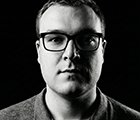
Adam Porkolab
Krummholz Fugleman
Adam’s fiction is forthcoming in The Pink Hydra. He holds a PhD in Linguistics and writes in both Hungarian and English. When not writing, he builds distributed systems and argues with compilers.
-
Do you use a pseudonym? Why or why not?
No. I'm Adam Porkolab — that's my legal name, the one I sign as Dr. Porkoláb Ádám back home. I dropped the accent marks for publication. Most editors would strip them anyway, and keeping them just means extra emails and extra proofreading rounds over characters that half the typesetting systems on Earth will mangle. The work should do the talking, not the diacritics. If a story can't hold your attention without a foreign-looking byline, it doesn't deserve your attention in the first place.What works do you feel have been left out of the western literary canon — works from other countries, in other languages, or by marginalized people?
The entire body of Central and Eastern European speculative fiction, for a start. Where is Stanisław Lem's The Cyberiad in the conversation about the greatest comic fiction? Where is Frigyes Karinthy's Voyage to Faremido (1916), a Hungarian proto-SF novel about sentient machines, written before R.U.R. coined the word "robot"? Where is Bulgakov's The Master and Margarita, arguably the greatest fantasy novel of the 20th century, shelved under "literary fiction" because it's Russian?Hungarian literature exists in a kind of linguistic quarantine. We have one of the most demanding literary traditions in Europe, and almost none of it crosses over. Kosztolányi, Krúdy, Mészöly, Ottlik — these writers would be household names if they'd had the luck to write in English or French. Thank God for Kertész Imre's Nobel in 2002 and Krasznahorkai László's in 2025. The stranglehold is starting to loosen. But there's still a long way to go.
What writers/artists/filmmakers/musicians have influenced your work — either the work itself, or the way in which you work?
Hungarian literature will always be in my writerly DNA. I spent years teaching literature and history, and that shaped me before I ever tried to shape a story. It's less an influence and more an aesthetic paradigm for me — untranslatable, locked behind linguistic grids, a literature of extremes that either chatters or strikes, like a heartbeat. The poets gave me my moral compass: Babits, József Attila, Radnóti. Among prose writers, Kosztolányi taught me that a child's point of view can unlock the whole world, and Mikszáth Kálmán — son of the same Palóc hill country I come from — showed me that folk horror and village gossip are the same thing, and neither one is lying.The Western classics came later. In Hungary, much of this was unavailable until the fall of communism. My absolute role model is Philip K. Dick — his speed, his restlessness, the way an idea would seize him and he'd chase it down in weeks. His Hungarian translations are unfortunately poor, which is part of why I ended up reading in English. Stanisław Lem is a kindred spirit: science fiction that's also philosophy, also comedy, also deeply, unfashionably humane. I learned horror from Stephen King, not to imitate him but to find my own voice by studying how precisely he controls his. Borges taught me that an encyclopedia entry can be a horror story. Bradbury taught me to love a sentence the way you love a person — unreasonably, and without apology.
Is there one part of your creation process that's harder for you?
Translation. I can only write in Hungarian — that's my working language, the one where my instincts live. I read English fluently and I can write in it, but the creative ignition only happens in Hungarian. And "translate" is the wrong word for what happens next. The English version is practically sixty percent of the original. I rewrite, I cut, I restructure. Hungarian is agglutinative — a single word can carry what English needs a full clause to express. So the English version isn't a translation, but rather a second organism—one that shares the original's skeleton while growing different muscles, sometimes even beating with a different heart.I also never stop polishing. After every three rejections, I go back and ask whether the English is doing everything the Hungarian did. Sometimes a rejection isn't about the story at all — it's about a rhythm that didn't carry over, a joke that only works in Hungarian. That revision cycle is the hardest part of my process, and also the part that makes the work better than I could make it in a single pass.
How do you handle rejection? Do you have any advice for other creators about handling rejection?
Most of my submission process is automated. I run my own server with my own database — every submission, every rejection, every response time, logged and tracked. I work on a monthly submission rate. This sounds clinical, but it's actually the opposite — it removes the emotional narrative. A rejection isn't a judgment on your soul. It's a row in a table. The table doesn't care about your feelings, and that's the kindest thing about it.I allow myself exactly ten seconds of being upset per rejection. Then I log it and start looking for the next market. Same day. Always same day.
What still hurts — genuinely hurts — is the "almost." The longlisted-but-not-picked. The "we loved this, but we just bought a witch story last week." Those prove the work was good enough, and the answer was still no. You can't automate your way out of that feeling. You just sit with it for a moment, and then you move.
I call my approach the PPSh method, after the old Soviet submachine gun. The PPSh-41 wasn't the most accurate weapon ever made, but it fired and fired and fired. For every finished story, I target as many simultaneous-submission-friendly markets as I legally can, as fast as I can. One of my stories was rejected six times before it was accepted — by a market that sent a personal note calling it one of the strongest pieces in their reading period. Same story, seven different desks, seven different answers. And the moment that acceptance came in, I withdrew the story from every other market where it was still pending. Immediately, same day. That's not optional — that's basic professionalism. Editors remember who wastes their time, and they remember who doesn't.
Form rejections are not about you. They can't be — the editor spent sixty seconds on your story. Personal rejections are gifts, even when they sting, because someone bothered to tell you why. The worst thing in this business isn't rejection. It's silence.
What is your biggest creative doubt?
That the thing I'm best at might also be the thing that makes my work hardest to place. I write what I sometimes call "love-fi" — speculative fiction that uses science fiction and fantasy as a disguise for something uncomfortably intimate. My characters set the table for Death and pour him coffee. They call Death beautiful so he'll smile (yes, Death is usually male in Hungarian). The speculative element is real, but it's not the point. The point is always the human thing underneath.I worry sometimes that this falls between chairs. Too strange for literary fiction, too quiet for genre. Too American, too different for the Hungarian market — and I take that as a compliment. But I'm grateful to the Anglophone market. It taught me to write better — to always reach for the sharper sentence, the rounder thought. My Hungarianness isn't a limitation but the material. English is my second, chosen language, one I respect and care for deeply. And I feel I have a great deal more to say to the English-speaking audience.
What piece of creative advice have you received that sounded good, but was ultimately not useful to you?
"Write what you know."I'm a software engineer with a PhD in Linguistics. I grew up in a Hungarian village called Tar — which means "bald" in Hungarian and, well, you know what it means in English. I didn't have internet access until I was sixteen. Every foreign film and novel reached me in translation — and Hungarian translations of that era had the authenticity of an eighty-three-year-old Hungarian schoolteacher of English attempting to render the latest US slang. If I wrote what I knew, you'd get a story about a man debugging a Java microservice while conjugating irregular verbs in a language you've never heard of. (Actually, I might write that one day. But it would still have a ghost in it.)
The better version of this advice: write about what's strange. You're watching a YouTube short about Japanese self-mummification at midnight, and then the algorithm serves you a surgeon analyzing a video of a Mexican man who survived an accident that should have killed him. Connect them. That's a story. Write about what unsettles you, not what you already understand. I write down every stupid idea I have, consciously, deliberately. Most of them are useless. Some of them aren't. I also hunt for English words I don't know — words that have no Hungarian equivalent, words that name things I didn't realize had names. A new word is a new room in the house. Sometimes there's a story living in it.

Sambhu Ramachandran
Phytanthropy
Sambhu is an Assistant Professor of English at N.S.S. College, Pandalam. His poems have appeared in Neon & Smoke, The Tiger Moth Review, Prosetrics, The Alexander Review, The Bombay Literary Magazine, Wild Court, and Sextet, among others.
Liz Vaughan
Road Trip
Liz is a genre-nonconforming writer from North Carolina, where they are earning their MFA in fiction at UNC Wilmington. Their speculative work appears or is forthcoming in 100-Foot Crow, The Vincent Brothers Review, and Lambda Magazine.