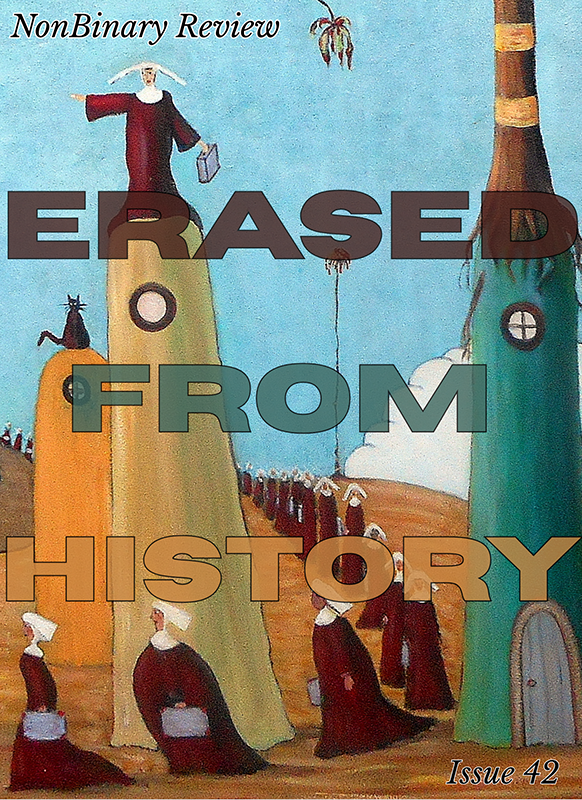
Issue #42: Erased From History
-
Most of the people I know belong to groups whose histories and achievements have been erased from history— people who exist outside the gender binary, people of color, people whose primary language isn’t English, people with physical, mental, or emotional limitations.
If you live in the United States, to belong to a marginalized group is to have to take education into your own hands, exploring the histories of people like you, if only to validate that your identity is real. Discovering the contributions people like you made to the world. It’s inspiring to know that people like you can overcome society’s prejudices enough to have their work taken seriously. If you live in a place that some refer to as the “third world,” you get to live with a mix of amusement and anger at the fact that the Western world has no idea of the rich history of invention and culture that goes back further than most Western countries have existed.
But how does that erasure happen? It comes down to the old saying “history is written by the winners.” After centuries of exploration, trading and absorbing the achievements of other cultures (gunpowder, the numeral zero, the movable type printing press, eyeglasses, coffee, tea, chocolate), Western Europeans who had been living in unsanitary, overcrowded cities got onto unsanitary, overcrowded ships and fought wars against those other cultures, usually overcoming them with a combination of superior firearms and novel diseases against which those cultures had no defenses.
Wherever you live on Earth, you live in a place where others have lived before you. Where I live, the Awaswas, a group that lived in the area for 12,000 years before the Spanish arrived, were decimated by economic competition, European religious policies that included suppressing indigenous languages and cultures.
What breaks my heart isn’t the litany of groups wiped out by invading forces— if they’re part of that litany, we know about them. What makes me sad is the knowledge that there are groups completely unknown to us because they were so thoroughly erased. Entire civilizations with their own languages and customs, their own celebrations and observances. Gone.
We can only speculate about what those civilizations might have been like, but that’s what we do here—speculative fiction, poetry, and art. The beauty of speculative work is that we don’t have to limit our ideas to what we know. We don’t have to extrapolate based on information we have of little-documented cultures. We can make up what we wish were true. What might be true in an alternate universe, on another planet, or only inside the privacy of our own minds.
It’s unlikely that any groups existing at this time would be entirely lost to future history, mostly because we live in an age of ubiquitous surveillance and unceasing documentation. But just in case, I think we should carpet the world in as much weirdness as possible, just so that future generations will look back on us and think “wait…that can’t be right.”
Allons-y!
Li Quintana
Publisher

David Boyle
Nun’s March
David is a Wellington artist.He entered a similar short story about a were/ rat into The Rangitawa Collection of Short Stories by New Zealand Authors 2013 and Twisted Tax Tales Short Story which they both published.

Lawrence Bridges
Coppicing
Lawrence’s poetry has appeared in The New Yorker, Poetry, and Tampa Review. He has published three volumes of poetry: Horses on Drums (Red Hen Press, 2006), Flip Days (Red Hen Press, 2009), and Brownwood (Tupelo Press, 2016). You can find him on IG: @larrybridges
Allison Burris
Stephen Hawking’s Cocktail Party
Allison received her MLIS from San Jose State University, her whimsical poetry appears and is forthcoming in Passionfruit Review, Hoxie Gorge Review, Heartlines Spec, and Metphrastics. Connect with her via https://linktr.ee/allisonburris.
-
Do you use a pseudonym? Why or why not?
I don’t use a pseudonym. I think it’s hard enough for poetry to find readers, I certainly want my friends and family to be able to find my work. I write privately, but I publish publicly. If there’s something I didn’t want others to read, I would keep it to myself…What first motivated you to write/create art?
My second grade teacher introduced us to Emily Dickinson and The Wonderful Wizard of Oz. My mom was always reading to me and then with me. I can’t remember a time when words and language didn’t spark a sense of wonder and urge me to look more closely.Is there a specific period of history whose art or writing you admire? Why?
I am constantly inspired by art nouveau and art deco styles when I do visual art— I love the way they pull elements from nature and then stylize them, but writing is trickier to narrow down. In any period, I admire wit and wonder, curiosity and cleverness. I love contemporary writing because I think more diverse experiences and perspectives are being shared than ever before.Is there one part of your creation process that’s harder for you?
I have a tendency to work too quickly. I edit and leave typos in my wake, or I don’t sit with a piece very long before sending it out into the world and end up making major edits later. This isn’t always a problem, but I try to build more time into my process so that I can be more precise, to let words marinate and tenderize. For example, I write my first drafts longhand and then I leave them in the notebook until the notebook is full before going back and typing/editing/revising. Generally, I throw out at least a third of the material I’ve generated because I can look at it as an editor rather than in the throws of whatever emotion I was feeling at the time.Talk about the moment you knew you wanted to be a creator.
I’ve tried to do other things, but I just keep coming back to making things. As soon as I realized that the fear of failure was never going to just go away, it became the permission I needed to just try.Do you have a piece that you created early in your career that makes you cringe? Will you ever go back and fix it so it can be submitted somewhere?
Oh of course. There’s pieces I wrote last month that make me cringe. I hate when I just start whining on the page, but the feelings just need to come out even if they don’t make it into anything finished. Sometimes you get a line or idea that you can salvage and collage into something else and sometimes you just have to accept that you had to write that poem to write a better poem later. I try to treat early work as a snapshot and not get caught up in what I would change now. I can’t go back and fix a bad haircut, but it taught me what to ask the stylist.What is your biggest creative doubt?
Honestly, it’s that my happy, fairly well-adjusted childhood just doesn’t have enough fodder for really excellent poetry. Sometimes I feel like a fraud because I don’t have this deep well of pain or experience to draw on—which in turn may mean that I’m not deep as a person. I wanted to erase this as soon as I wrote it because it sounds so dumb, but I think that just means it feels really true. I’m leaving it.You’re stranded on a desert island - what three creative tools do you want with you?
There are so many tools you can make—if you can make a fire, you can use charcoal. There are probably ways to make inks/paint out of different substances. You could sharpen a twig or root and make a stylus. Or get a feather. You can strip bark or write on a rock… If there’s nothing available I won’t live long enough to be creative, but I’d write in the sand with shells if necessary.I’d want a knife so I could manipulate materials. I’d want something to read so that I could have something to remind me that I’m a language driven being (plus you can write between the lines if needed). So make that two books and a knife—I think I could experiment with the rest.

Mike Callaghan
don’t think you ever once got to hear me sing
Mike focuses on fragmentation/rearrangement/reinterpretation. His work was exhibited at Griffin Museum of Photography, Marin Museum of Contemporary Art, Soho Photo Gallery and PhotoIreland.
Jack Feerick
Red Sunset
Jack has been a working writer for two decades, contributing reported features and research pieces for the kind of magazines your mom reads. When not squeaking out a living as a freelance proofreader, he plays for a rock’n’roll band and works at raising two genderqueer kids.
-
Do you use a pseudonym? Why or why not?
I used to go by “Jack Fear” back in my punk rock days, because it was tradition. But the whole practice of punk pseudonyms started so that artists could earn money from their art while continuing to claim unemployment benefits under their government names. I always had a day job and never made any money to speak of from art, so what was the point?What first motivated you to write/create art?
Many creative people say they went into the arts because “I was never any good at anything else,” but I don’t believe that’s the case. The truth, for many of us, is that we never bothered to get good at anything else. I probably could have been a perfectly adequate accountant, if I’d worked at it—but I didn’t. Consciously or unconsciously, I cut off all my avenues of retreat until this was my only way forward.Is there one part of your creation process that’s harder for you?
The hardest part creatively is knowing when a project is finished. The hardest part emotionally is knowing when to give up.Do you have a piece that you created early in your career that makes you cringe? Will you ever go back and fix it so it can be submitted somewhere?
Funny you should ask: “Red Sunset” was actually radically reworked from a comics script I wrote many years ago. I believe it was John Ciardi who said that a young poet should write as much—and publish as little—as possible. The value of that cringey early work is in getting the ideas out of your head and onto the page. Once you’ve done that, if it’s a good idea, you have the rest of your life to nail the execution.What is your biggest creative doubt?
Society needs artists because the artist has a unique sensibility—but the work can only be seen if that sensibility connects with somebody else’s. I haven’t got a commercial bone in my body; I only know how to make the kind of work that I enjoy. What keeps me up at night is wondering if that work will ever resonate with even one other person. And it’s always a surprise and a delight when it does.What piece of creative advice have you received that sounded good, but was ultimately not useful to you?
Let me qualify this a little: “Begin as close to the end as possible” is the cardinal rule for a finished story—but I find it impossible to follow during the first-draft process. The way I write a 1,700-word story is to write 5,000 words, following a character from birth ‘til last Tuesday, and then throw away the first two-thirds. It’s inefficient; it’s time-consuming; but it’s the only way I know how to do it. In the edit? Yes, begin as close to the end as possible. But in the draft? Take me back to the Big Bang, y’all, and see where we go from there.
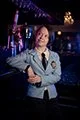
Jennifer Frederick
Queer History
Jennifer is an artist, a writer, and a lawyer in Maryland. They have been writing for years and creating collages since 2016. They are the author of the Coffee Table Book of Pride Flags: Discovering the LGBT+ Community Through Art.
-
What first motivated you to write/create art?
I started creating collages as part of my fine arts requirement in college in 2016, and I almost immediately fell in love with it once we moved away from construction paper. I was a political science major, and a lot of my art became political as a way of processing my emotions around the turmoil of the world around me. It still is, so I never really lost that. That one 2-D design class in college really sparked something for me that I still hold onto to this day.If you could have any writer/artist, living or dead, as a mentor, who would you choose?
Eric Carle, the artist behind the Very Hungry Caterpillar. He has an art style that I love, and I would love to talk to him about how he picked up on it. He was also a collage artist, and his work is stunning. I would love to learn more from him.Is there one part of your creation process that’s harder for you?
I try to modge-podge all of my pieces to seal them when I’m done. Paper is really finicky when it comes to being glued down, but I hate modge-podging. It takes a little bit of time, but then I have to find a place to put it that I or the cat won’t step on it, and then I have to clean the brush I use. Definitely my least favorite part that I’ll let pile up.Talk about the moment you knew you wanted to be a creator.
Art has always been really important to me. I started ballet classes at the age of 2, I create collages, I write, I sew, I cosplay. I made shoes recently (that was a weird one, and I’m going to do it again.) Creating has never really felt like a decision for me, it’s a vital part of my life. The real question is where it will go next.What is your biggest creative doubt?
I worry a lot about my work lasting at all. I work in paper which likes to fall apart even now if I'm not careful, and I’ve only been creating a decade. I have to replace pieces and such, it doesn’t have the holding power of a lot of other art forms, and it gnaws at me sometimes.You’re stranded on a desert island - what three creative tools do you want with you?
Scissors, glue sticks, and a notebook. This is about all I use to create anyways, so it works, right? Joys of a collage artist.
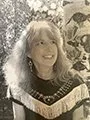
Juley Harvey
chills and spills
Juley is a prize-winning poet and former journalist in both California and Colorado. She belongs to 3 writers groups — 2 by zoom, Writers on the Brink in Estes Park, CO, and TallGrass Writers in Chicago, and Dianna Hennig’s in Susanville.

Vali Hawkins-Mitchell
Descansos
Vali works and writes from her office across the street from the Honolulu Zoo, where she works as a Trauma & Disaster responder. She is published in numerous journals, For more information about her books and art please see www.valihawkinsmitchell.com or her company at www.eapacific.com
-
Do you use a pseudonym? Why or why not?
No. I want people to know me. And those who already know can find my work, so they won’t think I just talk about writing all the time for no reason. And I think my name is interesting and “writerly” enough.What first motivated you to write/create art?
I come from a family of musicians and artists, so it was never a question of “if” but only what medium would be my “superpower.” I tried many with some success, but writing is what has always been the strongest magnet of my energy.If you could have any writer/artist, living or dead, as a mentor, who would you choose?
First thought, Hemingway, because of the Moveable Feast, but then Georges Seurat, because of A Sunday on the Grand Jete. Either one because they both found ways to laser their points by directing attention to what mattered, either with words or colors.Is there one part of your creation process that’s harder for you?
The juxtaposition between the simple and private blessing of doing the work and the annoyance of wanting others witness it. In fact, right now, go to my website.Do you have a piece that you created early in your career that makes you cringe? Will you ever go back and fix it so it can be submitted somewhere?
Yes, before I found the treasure of a good editor. No, I don’t care about that subject now and the cringe remains. (ugh, thanks for reminding me!)What is your biggest creative doubt?
Will I live long enough to get everything I want to write written.What piece of creative advice have you received that sounded good, but was ultimately not useful to you?
To have others critique your work. But they didn’t explain that it shouldn’t happen too early in the creative process or how to choose excellent editors and creative critics. That I had to learn myself.You’re stranded on a desert island – what three creative tools do you want with you?
Water-resistant notebook, a box of extra fine tip sharpies, and a lovely quilt to sit on to make myself a “sweet writing spot.”
Miranda Jensen
Whose Veil
Miranda is a creative activist with roots in the San Francisco Bay Area. Through her writing and critical theory, she seeks not merely to interpret the world, but to change it. You can find her at www.mirandajensen.com and on X @MirandaLJensen.
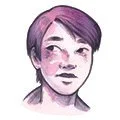
Toshiya Kamei
Where the Ink Ran Dry
Toshiya takes inspiration from fairy tales, folklore, and mythology. She attempts to reimagine the past, present, and future while shifting between perspectives. Many of her characters are outsiders living on the margins of society. For more information, visit toshiyakamei.wordpress.com/.
Ellen Kombiyil
she shed tears
Ellen’s latest poetry collection, Love as Invasive Species (Cornerstone 2024), is a tête-bêche exploring matrilineal inheritances. A recipient of a BRIO Award (2022, 2025) from the Bronx Council on the Arts, and an Academy of American Poets college prize, she teaches writing at Hunter College.
Anne Liberton
nascente
Anne is an autistic Brazilian author fascinated by all things weird, from fiction and poetry to people. Her work has appeared in Diabolical Plots, Strange Horizons, Small Wonders and more. She took part in the 2021 Clarion West Novella workshop. You can find her @anneliberton or at anneliberton.carrd.co.
-
Do you use a pseudonym? Why or why not?
Yes. I don't really like my name (never have), so I created one many years ago, even before I started writing. When I finally did, it seemed natural to use it. Most people know me as Anne.What first motivated you to write/create art?
I have always been very artistic, drawing, singing, creating things from scratch, so I guess writing would have to come along at some point. The first story I ever remember writing was a demon/angel fantasy novelette when I was thirteen. I just thought about a story and then put it on paper. After that, I never stopped. As for poems, I started quite meekly during a Facebook event a few years ago that required you to write one poem a day based on a prompt (I think I wrote 5 out of 30, haha).If you could have any writer/artist, living or dead, as a mentor, who would you choose?
Either Emily Dickinson or Vinícius de Moraes, both extremely talented poets. Writing poetry has made me a better writer, but I still think I need a little practice, and their style just draws me in.Is there a specific period of history whose art or writing you admire? Why?
The Romantic period, mostly because my favorite composers are Romantic ones (Schubert, Tchaikosvky).Is there one part of your creation process that’s harder for you?
Anything involving descriptions, because imagining details like clothes, facial features and such doesn't come naturally to me. I also enjoy poetry a lot because of this, since I can basically do anything I want.Talk about the moment you knew you wanted to be a creator.
I think that actually happened while I was drawing Sailor Moon in my notebook in middle school. It just felt right doing things from scratch.Do you have a piece that you created early in your career that makes you cringe? Will you ever go back and fix it so it can be submitted somewhere?
Yes, but I don't "fix" things that are complete. We keep on changing, evolving, and so do our opinions. Even a "perfect" work would need some fixing at some point if I just let myself do that. It's a never-ending effort and, if I may, quite pointless. The work is what it is.What is your biggest creative doubt?
The closest thing I have to that is wondering how to spell a word, since English is my second language.What piece of creative advice have you received that sounded good, but was ultimately not useful to you?
Usually those that sound like ultimata or direct vocabulary suggestions, like "abolish -ly adverbs," "show, don't tell," "words to use instead of 'said'". Each work has its own peculiarities.You’re stranded on a desert island - what three creative tools do you want with you?
Paper, pencil, eraser (I hate hate hate crossing out words).
Jeff Mann
sounds of silence
Jeff lives in Fort Erie Ontario, near Buffalo. Jeff has been steadily moving West from Maine to upstate New York to Kingston, Ontario then to the Niagara River. Somewhere along the way, he discovered car parts and it’s been all downhill from there.
-
Do you have a piece that you created early in your career that makes you cringe? Will you ever go back and fix it so it can be submitted somewhere?
Yes. However, two thoughts. Just because my aesthetic has changed/evolved doesn’t mean I need to cringe, I’ve just moved on and since ultimately the image/sculpture/painting is for others to appreciate—otherwise I may as well work in a cave—I find that there is always someone out there to whom my images speak.I often go back and rework images to such an extent that I keep an “old/original” folder of images in case I submitted an original and need to go back to them even though the current image has been considerably altered from the original. I do this now digitally, but it wasn’t uncommon for me to either rework a “finished” sculpture or leave it hanging on the wall until the final steps came to me. AND even though I may not have gotten it right in the first edition, I can use the old image as a prompt.
You’re stranded on a desert island - what three creative tools do you want with you?
Lock me in a junkyard with metal working tools. I’d be gone forever.What is your biggest creative doubt?
I work through response rather than narrative or vision (those may get added later), so knowing when I’m done can be difficult. And I can often feel doubt which wants me to abandon an approach even though most time if I stick with it, I will find the combination that works and frees me to focus in on the finished piece. I often create “screens” which are blank shapes to be filled in with content. Matching shapes to content can be time consuming and lead to doubt.Talk about the moment you knew you wanted to be a creator.
Grade 5 I brought in rhubarb sauce to spread and dry on paper as the basis of a project. I loved the groupings of lines, but it didn’t show up very well so I ate the rest. Positive reinforcement for blown creativity.If you could have any writer/artist, living or dead, as a mentor, who would you choose?
Hundertwasser. His work was so child like and his environmental ideas were so amazing. I received a grant to build on his idea of painting the exterior area around an apartment’s window reflecting the occupant. I worked with a group of subsidized housing residents. We created full size surrounds on paper and used them as the basis for our art show at a local art centre. Loved the energy.
Jeannie Marschall
Home, Sweet Home
Jeannie is a garden hag from the green centre of Germany who writes colourful, queer SFF stories & poems and enjoys hikes, foraging, and crawling critters. Longer works are in the cauldron (ETA late 2025). Bluesky: @JeannieMarschall.bsky.social
Patrick McEvoy
Looming
Patrick has had illustrated stories appear in Santa Fe Review and Best of Penumbric Vol. 6 while also being included in TAG’s Made in the USA exhibit in LA. “Um” has been published by Metastellar. Short plays have appeared in festivals and photography has been exhibited online and elsewhere.
-
If you could have any writer/artist, living or dead, as a mentor, who would you choose?
I feel my answer would change with age. I would’ve definitely said Enid Blyton as a child, and there’d be an unending list which changed on a daily basis as a teenager, but my all time favourite writer is Diana Wynne Jones. Of course, my current mentor, Lindz Mcleod, is absolutely wonderful, too.Is there one part of your creation process that’s harder for you?
I have way too many ideas and it is very difficult to narrow things down. I often write a combination of two or three ideas together, which yields to surprising effects. It’s sometimes very hard not to doubt myself, and the choices I’ve made in my writing. But in the end, it usually works out, as long as I have fully grasped the core of my story.Talk about the moment you knew you wanted to be a creator.
Throughout my life, there are stories I’ve read which have reached into the deepest and softest part of me, and touched my soul. I feel myself changed by them and I carry these stories inside me. So I guess it is not a moment, but a number of moments where I am awestruck. To be able to create and influence and change someone the way writers could, is such a magical ability. I aspire to wield that magic, even just a little bit.Do you have a piece that you created early in your career that makes you cringe? Will you ever go back and fix it so it can be submitted somewhere?
As a teenager with huge feelings, I’ve written myself a whole fantasy series worth of cringe. I’d definitely want to go back and salvage the plot because I still believe in the story, but I’ll probably need a lot more time before I can go back.What is your biggest creative doubt?
Sometimes I’d write myself into tight spots and wonder, will this story make it? Or will it be another abandoned project in the drawer? Do I have it in me to write or fix or come up with a good story? I’m scared that once I call it a day, the story will remain unfinished forever.What piece of creative advice have you received that sounded good, but was ultimately not useful to you?
Write every day. The pressure is too big. I’m constantly checking: how many words have I written today? Am I a failure because I’ve skipped a day, which easily turns into two, then three.
Irina Tall Novikova
Girl
Irina is an artist, illustrator. She graduated from the State Academy of Slavic Cultures with a degree in art, and also has a bachelor’s degree in design. The first personal exhibition “My soul is like a wild hawk” (2002) was held in the museum of Maxim Bagdanovich.
Ellis Nye
Five Books Unreturned When the Library Vanished
Ellis is a scientist, fiber artist, and writer. They live in New England.
-
If you could have any writer/artist, living or dead, as a mentor, who would you choose?
There are so many authors I would love to learn from. My first thought was Octavia Butler, since she’s my favorite author. I appreciate how much passion she had for writing, and how much that shines through in her work. And I love how weird her work is!But when I think about areas of my craft that I want to improve, I have to go with Diana Wynne Jones for my answer. There are so many layers to her writing. I read most of her books for the first time as a child, and they were wonderful books that made me think about all kinds of interesting things and that shaped my own writing deeply. But when I come back to them as an adult, there’s always something new for me, both because she layered her stories so richly and because I’ve grown and changed since my last read and I’m bringing a new perspective. Even when I read her books now, I still miss things, because I enjoy the books on an entertainment level so much that I forget to turn my analytical brain on.I’ve been following the Eight Days of Diana Wynne Jones podcast, and my favorite episode is probably the Fire and Hemlock one. It goes so in-depth, and pulls out themes that I hadn’t realized were in the story.I would love to be able to talk to Jones about how she did that. I attempt that kind of thing in my own work, and it’s exhausting to try to jam all these themes and symbols and allusions into one piece of writing. I believe she did write about how she accomplished this in some of her essays, but I’ve been putting off reading them because I want to savor the few bits of Jones’s writing that I haven’t read yet.She was also, sneakily, great at evoking emotion. I don’t tend to think of her that way, because when I think about authors who are good at emotion, I think about authors who can make me cry. Dogsbody aside, Jones’s work doesn’t often do that to me. But she was so good at evoking dread. I love dread! So much of my own writing is about dread, anxiety, grief, and the lack of autonomy and agency that we afford children—themes that I’m interested in both because of my own life experiences, and because of Jones’s work. (In writing this answer, I kept pausing because I’d noticed yet another Jonesian attempt in one of my short stories that I hadn’t consciously meant to put there. Damn you and your influence, Diana Wynne Jones!) The Time of the Ghost is one of the most quietly horrifying books I’ve ever read, and it becomes even more horrifying with every read.And a third area where I’d love to learn from Jones: I want to write more interestingly. She isn’t top of my list for beautiful prose, but her writing is inventive, and often unexpected. Especially her descriptions of characters and settings. I love the passage in The Time of the Ghost describing the Dream Landscape, as well as the bit about the countryside in the beginning. And she excelled at writing these quick, sharp little portraits of characters that instantly tell you everything you need to know about them.
Is there one part of your creation process that’s harder for you?
I do a lot of thinking before I write; there are certain elements of a story I need to have lined up in my head before I put the first word on the page. If I’m missing any of those elements, I get completely stuck, and if I try to push through it, the writing I produce is low-quality.Talk about the moment you knew you wanted to be a creator.
I knew that I wanted to be a writer from the get-go. I was so sure that this was what I was going to do that it felt like a foregone conclusion, and I put surprisingly little effort into becoming a good writer throughout most of my life. I’d take a class here or submit to a contest there, but I mostly came up with cool ideas, wrote a terrible draft or two, and daydreamed about what the finished product would look like.And then in 2022, my rent went up by an amount that was so large I initially assumed it must be illegal and I thought I might try monetizing the writing thing. (Mixed results thus far.)Do you have a piece that you created early in your career that makes you cringe? Will you ever go back and fix it so it can be submitted somewhere?
I’ve been writing stories since I was able to string a narrative together, so there’s plenty to cringe at. The majority of the awful stuff is from when I was much younger and much less socially aware. I know I’ve got a poorly thought-out gender plague story somewhere in my old files; I assume it’s trans-exclusionary as hell (irony!) but I don’t want to look at it to find out.What piece of creative advice have you received that sounded good, but was ultimately not useful to you?
A lot of cliché writing advice has been useful for me. I often need to kill my darlings, and I frequently have to remind myself to show in addition to telling—my first drafts tend to be a very bare bones, “He did this and then she did that. They looked at each other for a while.” The one that’s completely not for me is “Write every day”. I’m disabled in a way that affects my energy levels, and I just don’t have the time or energy to write that frequently, at least not for long. There’s a grain of usefulness there, as I’d like to train myself to be someone who can sit down and write on command whenever I have spare time. Right now, I can only write if I’m inspired. (Sometimes the thing that’s inspiring me is a deadline.)You’re stranded on a desert island - what three creative tools do you want with you?
A fountain pen with a big metal nib. I wouldn’t know how to write with it, but I can sharpen the nib to use as a small knife.2: Veering over into some of my other creative pursuits, a nice ball of thin-but-sturdy yarn. It’s important to always have some kind of string!3: One of those spiral bound notebooks that’s meant for students, with the scientific information on the inside of the cover. Some of that information could come in handy, and I can use the paper for kindling and the wire for fishhooks.
Jacklyn Oh
A Voice From the Past
Jacklyn is from Singapore. She used to work in finance but now spends most of her time daydreaming about strange new worlds.
W.L. Peters
A Letter from your Overlords
W. L. is a Canadian writer based in Belize, where they split their time between working on an epic fantasy series, writing short stories, and trying to keep sand out of their keyboard. He is gearing up to start a family, but for now, life is ruled by writing.
-
Do you use a pseudonym? Why or why not?
I do, W.L. Peters. I’m the only one in my family to have two middle names, I always wondered why. When I decided to start writing I found out. It was to have a cool author name. Thanks mom and dad!What first motivated you to write/create art?
Initially it was an escape. I started reading young. It took me away from the tumult around me as a child, and I loved it. I started with Artemis Fowl, Series of Unfortunate Events and things like Harry Potter and Lord of the Rings. It let me leave the world behind and have something just for me. Since then I always wanted to create something that could help transport, transform and ultimately transmute something difficult into something delightful.If you could have any writer/artist, living or dead, as a mentor, who would you choose?
I feel stuck between two for very different reasons. Tolkien might seem a cliche choice to some, but I would love him as a mentor for one main reason, we are both great admirers of nature. We could sit under a tree and create worlds together, I could take up pipe smoking. Otherwise I would have loved to spend time with Terry Pratchett for no other reason than he seems like the most delightful goofball that would always keep writing fun and fresh.Is there one part of your creation process that’s harder for you?
Doing it justice. I feel like I have so much creative energy, so many worlds and ideas. The most difficult part for me is getting it all out! I constantly need to study, improve my vocabulary and broaden my horizons so I can continue to learn new ways to implant the precise mental picture I have in my mind, into others.Talk about the moment you knew you wanted to be a creator.
The very first time I wrote something was for my little brothers. I would have been about 10 and I started creating Winnie the Pooh books that were more action packed than usual to read before bed. I’ve always loved telling jokes, I love talking about my favorite books and their worlds, I became a “Dungeon Master” for a group of my closest friends. In 2020 I made a big jump and left Canada for a while and moved to a little island off the coast of Belize. After looking within for long enough I uncovered a buried dream. Something I always talked myself out of through the years for one reason or another. Writing. I sat down and started that night and haven’t stopped since.What piece of creative advice have you received that sounded good, but was ultimately not useful to you?
I watched a lecture that said writers need a designated writing area for themselves. While this is perfectly fine advice, and still valuable, I found that it limited me to only writing in that space instead of being open to writing anywhere and everywhere. I always have a notebook, my phone to take notes in, something. I can never plan when inspiration might strike, when a rousing speech might show up for one of my characters that I absolutely must record right away before it disappears. I’ve got to stay ready!You’re stranded on a desert island - what three creative tools do you want with you?
I love to journal. I write out my thoughts to separate them from myself. So I would say a very thick notebook and a quality pen. Outside of that I think I would pick a good book, something like “how to escape a desert island in three easy steps”.
C. J. Peterson
Strong Spirits: Proof Test
C. J. Peterson is a writer of science articles and science fiction.
Cecilia Quirk
Incident Alert
Cecelia is a queer writer ( he/she/they) of white settler descent based in Naarm (Melbourne), Australia. Their work has appeared in Aurealis Magazine and Third Man Press’s Locus and World Fantasy Award shortlisted anthology, Trouble the Waters.
-
Do you use a pseudonym? Why or why not?
I don’t use a pseudonym currently, though sometimes I think it would be a good idea. I am fortunate to have a fairly unique name that I have been told is well suited to the types of fiction I like to write.If you could have any writer/artist, living or dead, as a mentor, who would you choose?
At the moment I’m really into Russian experimental/avant-pop band Shortparis, particularly their frontman, who’s a lyricist, art historian and (along with the rest of the group) creator of some truly excellent music videos in addition to wonderful music. The band is a cooperative effort of course, but his compassion, erudition and intellectual honesty are inspiring. I think he and the whole group would have a lot to teach about how to maintain creative and moral integrity and be brave, especially in a political environment that makes expression and cultural critique very difficult.Is there a specific period of history whose art or writing you admire? Why?
Not a specific one—I love almost all of it. Not fond of that period of 17th century art that got all about Man Conquering the Wild with all the slaughter of animals in vivid chiaroscuro, or (controversially) much of John William Waterhouse, and the odd little thing like that. As a kid I spent a lot of time in museums and amongst art circles and I’ve been fortunate to travel and visit art museums in many different parts of the world. I also try to read broadly across time periods and continents, although I sadly only read in English and German proficiently so must acknowledge translation bias. I love to listen to music and watch films from many different places.Really I think right now! There’s a moral crisis around AI and low-value “content”. I would count myself amongst the sceptics. At the same time, if you’re willing to go searching for it, you can find excellent music from just about anywhere on earth, watch excellent movies from just about anywhere on earth, see excellent art from just about anywhere on earth. You do have to go looking beyond the algorithms and the enshittification of the internet is making that harder, but there is still a lot out there to find and a lot of it is wonderful.
Is there one part of your creation process that’s harder for you?
While I feel this is a rather banal answer: simply finding the time! I am fortunate to have a job that I find fulfilling and intellectually stimulating, but I often myself torn between turning my energy towards the work I do for money, that does achieve a social good I believe in, or towards the very lofty goal of changing the world through art.Talk about the moment you knew you wanted to be a creator.
There was no one moment when I decided I wanted to write, I have simply done it since I realised fiction was something I could participate in (so age 6 or so). However, I “got serious” about it probably at the age of 19 or so after a period of serious writer’s block. I realised that writing is simply something I had to do. Commercial success would be wonderful, but I will keep on writing regardless of if I am ever fortunate enough to achieve it. I simply must. I suspect a lot of writers feel the same way.Do you have a piece that you created early in your career that makes you cringe? Will you ever go back and fix it so it can be submitted somewhere?
My first attempt at an epic fantasy novel was written when I was 13-15 or so during the Bush Junior era (or Howard era for the Australians out there) and has some rather heavy-handed political allegories and some very clumsy attempts at all sorts of things in mimicry of the epic fantasy books I had been reading. I don’t know that I’d revisit the story with the intent of pursuing publication, but I have considered doing a live read-through and react as a podcast or youtube venture—as an exercise in being kind to my past self, not only critical, would be the goal.What is your biggest creative doubt?
Whether I will ever reach my personal measure of “success”, or whether the bar will just keep rising as I follow it. I must remember to try and enjoy the wins!You’re stranded on a desert island - what three creative tools do you want with you?
Notebook, pen, and some means of being able to listen to MY music.
Matthew Ross
Temporal Displacement Bureau: Case File
Matthew is a neurodivergent writer, editor, and English professor living in Los Angeles, CA. His fiction has appeared in Andromeda Spaceways Magazine, Even Cozier Cosmic, and Sci Phi Journal, amongst other places. Find him online @matthewrossphd
Jimmy Saekki
Muhajir
Jimmy was born in Seoul, South Korea and has lived in a dozen locations throughout his life. His poems have appeared in the ecopoetry anthology Poetics for the More-Than-Human World (Dispatches Editions) and are forthcoming in Whispers of the Seasons – A Contemporary Haiku Anthology (Fresh Words).

Sherry Shahan
Bodie
Sherry is a teal-haired septuagenarian who studies pole-dancing in a laid-back California beach town. She holds an MFA from Vermont College of Fine Arts and has been nominated for the Pushcart Prize in Poetry and Short Fiction.
Winniefred Sharp
Through the veil of History
Winnefred is a multidimensional artist navigating words and images in a world where all art is free from boundaries. They write, create clothes, videos, photographs but also lace pieces, because art is limitless in this existence.
-
Do you use a pseudonym? Why or why not?
While Winniefred is my real name, Sharp isn't actually my family name. I took it after the painter Dorothea Sharp, as I love her paintings and I really dislike my original name.What first motivated you to write/create art?
It just felt natural, like breathing.Is there one part of your creation process that’s harder for you?
Not deleting my work after a while, I lose interest when I'm done so I often delete my work but I'm trying to not do it anymore.Talk about the moment you knew you wanted to be a creator.
There isn't one specific moment. Making an outfit for a Band-Maid concert was when I realized I wanted to be serious about creating clothes, but besides that, all parts of my art came together with the years.Do you have a piece that you created early in your career that makes you cringe? Will you ever go back and fix it so it can be submitted somewhere?
I've tried a lot of things so I have a lot, but I'm pretty sure they all ended up in the trash can. I do remember some ideas I had that I thought were very good, still do, so I would absolutely remake them given the right opportunity.What is your biggest creative doubt?
If I'll be able to recreate the perfect vision I have in my mind, since often the problem is not the vision but technical skills and budget.You’re stranded on a desert island - what three creative tools do you want with you?
My camera, a needle and my computer to put it all together.

Lisa Timpf
The Ghost Town of the Past
Lisa’s poetry has appeared in Eye to the Telescope, StarLine, Triangulation: Seven-Day Weekend, and other venues. Her speculative poetry collection Cats and Dogs in Space is available from Hiraeth Publishing. You can find out more about Lisa’s writing projects at http://lisatimpf.blogspot.com/.
-
Do you use a pseudonym? Why or why not?
I considered using a pseudonym for some of my work, but decided against it. I figured if people liked my writing and wanted to buy more of it, I should make it easy for them to find it.What first motivated you to write/create art?
Writing is something that has always come naturally to me. When I was in grade school, we had a school newsletter, something really simple that was printed out on regular letter sized paper and stapled together. I had some of my writing published in the newsletter, and from then on I was hooked.If you could have any writer/artist, living or dead, as a mentor, who would you choose?
Wow, that’s a tough one. Maybe Julie Czerneda, a Canadian science fiction writer. I love her Esen character from the Web Shifter’s Library series. Or Canadian mystery writer Louise Penny, who writes the Gamache mysteries.Is there one part of your creation process that’s harder for you?
When writing short stories, I sometimes overthink the plotting process, and then my story loses momentum. When I knew less about the technical side of how a story works, I found it easier to write. Now, after doing a lot of reading about what elements should be present, I sometimes get stuck and lose momentum.Talk about the moment you knew you wanted to be a creator.
When I was at university, I volunteered as a sportswriter for the student newspaper. I got a charge out of seeing my stories in print, and it never got old for me.Do you have a piece that you created early in your career that makes you cringe? Will you ever go back and fix it so it can be submitted somewhere?
When I first started writing fiction, I wasn’t as aware of the importance of “own voices” as I am now. In one of my mystery stories, the protagonist was a female detective who was a former professional hockey player. Due to a hockey injury, she was now in a wheelchair. I wrote the story with good intentions (wanting to show ability rather than disability) and submitted the story. The editor made some suggestions that corrected misconceptions I had made. Now, I would either not make the protagonist someone who represents a group I do not belong to, or would make sure I had a sensitivity reader provide input on my portrayal.What is your biggest creative doubt?
My biggest creative doubt is whether my work is worth sending in. I try to follow the advice “don’t self-reject,” which motivates me to at least get my work out there. I also keep track of my submission/rejection ratio, which helps me put things in perspective.What piece of creative advice have you received that sounded good, but was ultimately not useful to you?
The advice that sounded good but I ultimately discarded was to write a certain number of words per day. It just didn’t work for me. I ended up being stressed out, particularly when I had other obligations to consider. Doing some writing every day, I can live with. But setting a specific target—not for me.You’re stranded on a desert island - what three creative tools do you want with you?
I could make do with a writing implement and a notebook.
Ugwu Kingsley Ikenna
Tears in The Gateway
Kingsley is a Nigerian of Igbo descent. Kingsley has a deep passion for literature. His environment has played a significant role in shaping his artistic perspective. He is a contributor on Spillwords and Eterna journal. For Kingsley, writing is a channel to educate and enlighten.
Kesper Wang
silicone
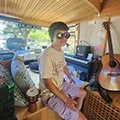
Kesper is an anti-capitalist climate advocate who likes skateboarding and biking. He graduated from the University of Chicago, and his poetry has been featured in Through These Realities, trans.monster, Boston Free Radio, and City of Somerville. He likes to paint, daydream, doodle, and blast reggaetón.
-
If you could have any writer/artist, living or dead, as a mentor, who would you choose?
I would choose Haruki Murakami. I have no idea what he is doing, but I’m obsessed. Murakami speaks to me as well because he isn’t a “trained” writer who went through an MFA. He began to randomly write one day, at the age of 29, and found that he liked it. I think about his books for days on end, and I don’t even know what I’m thinking about besides this undefinable, unsettled feeling, which only he can produce.Is there one part of your creation process that’s harder for you?
I hate editing, because I could do it forever, and I can rarely tell whether I’m making it worse or better. Usually I’m just so tired of looking at the thing that I click submit. It’s extra frustrating if I wrote the original in response to a current event that is now five years old. Then, no one gets the reference because of my toxic perfectionism.Talk about the moment you knew you wanted to be a creator.
I think I was around five years old. My mom would save lots of extra papers from her workplace that she didn’t want to throw away. Most of these papers had printing on one side, so I’d just flip them over and draw on the back. After a while, though, I accumulated enough pages that were blank on both sides. The first thing I did was fold them all in half and stack them inside each other, to make my first “book”! It was a cartoon with words and pictures.Do you have a piece that you created early in your career that makes you cringe? Will you ever go back and fix it so it can be submitted somewhere?
They are pretty much all cringe. I thought I was a literary genius when I first wrote them because I would get carried away in these states of rapture and inspiration. But what I’m recalling is the feeling, not the writing quality. So, when I reread them, it’s basically like, vomit emoji. Sometimes, though, I come upon astonishingly good pieces. I’d love to submit them one day, if only to honor my former self. Even if no one reads it, it’s like an emotional snapshot of my life at the time, which is neat.What is your biggest creative doubt?
I’m worried I should have done a different art form, like music. I chose writing because I felt like I could go deeper and explore more ideas, but music might be the real language of my heart.What piece of creative advice have you received that sounded good, but was ultimately not useful to you?
“Write every day for 3 hours, starting at 8 am.” I can’t do it. I’m not a morning person. I also have hobbies, friends, interests, and work, so if I lock myself in the house forcing myself to write, I just end up writing depressing content about how I’m locked in the house being forced to write. I want my writing to be infused with choice, not cranked out unnaturally.
Cassandra Whitaker
What This Fabric Could Tell
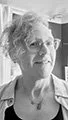
Cassandra (she/they) is a trans writer from Virginia whose work has been published in Michigan Quarterly Review, Beestung, Conjunctions, and other places. They are a member of the National Book Critics Circle and an educator.
-
What first motivated you to write/create art?
Wonder. Curiosity. To connect with others. To respond, answering another artist; hi, it’s me, I’m over here.If you could have any writer/artist, living or dead, as a mentor, who would you choose?
I’m not sure I would function well in a mentor mentee relationship. Though I would love to have been a fly on the wall when some of my favorite writers were working or discussing their work. Observing the Bard for a while, awesome, hanging out with O’Hara at lunch, fantastic, chilling at an Anne Sexton Her Kind set, absolutely, watching Ross Gay find delight in every interaction, magnificent.Is there a specific period of history whose art or writing you admire? Why?
As much as I love the Renaissance, or poetry from Ancient China, I keep looking forward for new ways to split hairs. I find there is exciting literature being crafted today, despite the lack of it on the bestseller list. There’s great work put out by the larger smaller poetry presses and independents today. Jos Charles, Michael Chang, Richard Siken, Don Mee Choi, KB Brookins, to name a few, are doing exciting things with poetry, memoir, prose that is impactful on the way I view the world, and my work.Is there one part of your creation process that’s harder for you?
Revision, which is largely about finding time to revise, and then wrestling with the changes in you or how you see the work in relation to the work as it stands. Promotion, which is creative work, and part of the process, but one I am terrible at. I could stand to use a little work in this area.Do you have a piece that you created early in your career that makes you cringe? Will you ever go back and fix it so it can be submitted somewhere?
Yes, always. I think most writers–as they age–look back at older work and find something akin to shame and revulsion starting back, which is part of the growth of an artist, to self reject one’s past to embrace the work as it manifests now. Sometimes it’s a minor thing, a word choice, a line change, or sometimes it’s just bad writing, or with a review, a place where the prose is overwritten, possibly even fan-girly, to the point where it’s obvious I’m crushing.What is your biggest creative doubt?
The self promotion –a self perpetuating drumbeat one has to grind out when it comes to selling or attracting readers. Poetry isn’t exactly pop music. I live in a rural area. There’s only so much of “scene”. Sometimes it feels like why bother. Sometimes I don’t have the spoons to drive anywhere between 40 and 90 minutes to be with other poets and writers.What piece of creative advice have you received that sounded good, but was ultimately not useful to you?
Write what you know–limiting advice, useful only at times, I suppose, and an awful tool for gatekeeping young writers in workshop.You’re stranded on a desert island - what three creative tools do you want with you?
Pen or pencil, paper, drum. Or maybe guitar.

Shan Xiaoming
The Public Bathroom
Shan is a Chinese English teacher who writes stories in English in his spare time. He is one of the very few Chinese writers who write in English from within China.