

Sometimes, you just have to go with what you have.
-
There in the boneyard, salt-cracked silence reigned.
The brutal sun beat down upon the slain.
The sea, great womb, retreats and fades by day,
and moonlight sheds her tears upon the plains.
Sun seethes, breathes arid wind and shifts the dunes.
Here in the maw of death, in this beast's veins,
some just survive; some live; some thrive. Outcasts,
by night they travel—lively, uncontained.
Magician conjures blooms, delights in glee.
In dance the priest entreats the gods for rain.
The gymnast swoops and soars and owns the skies.
Come to the circus—wonder's vast domain.
Come, see, and leave behind the throbbing beat
of poverty, the bone-deep stabs of pain.
Breathe deep, and taste a storm, the ocean's waves;
the tender, tart-sweet juice of fruit remains
upon your lips. Inhale. Cool air expands
you. Here they sing and save you. Entertain?
It's more than that. The dance is breath. The shows
let us forget our woes, and they sustain
the dreams of every wide-eyed child. Now rest— -
It rained for two days and two nights, and the rich smell of black creek-bottom mud was heavy when Elias Townley returned to his lonely work bench and the burning hammer. The land was green and beautiful after the storm; far off in the distant air, small brown birds twittered, and bigger, darker things squawked cruel replies. These were the sounds of the pine woods, and Elias knew them well.
There was only one other sound, repetitive and sharp, human and out of place in the living, wet woods, that Elias knew and loved better. It was the unnatural heartbeat of Bitter City, Alabama—the resounding slap and clang of hot steel on thin metal. From the first wink of dawn to the dark pitch of night, Elias cooked the steel head of his hammer and struck metal sheets into links, melting and folding and shaping until the sheets were light and curved as birds’ wings.
Bitter City had been a real city once. Elias remembered having neighbors and going to school, but that was before. He had only been a boy when his parents loaded up the trailer and fled deep into the woods. He couldn’t remember their faces now, but Elias was sure that he’d had real friends once. Human friends, with faces and voices.
After the move, Elias had been so lonely that he made up new friends to talk to. Sometimes, he talked to them still, though he knew he shouldn’t. His friends weren’t nice people. They weren’t good to him. One night, cocooned in his bedsheets, and laid out upon the dew-wet grass under a thick blanket of stars, Elias couldn’t help but listen to his new friends’ whispers in the dark. That night, they told him: this is the city, and the tower must be built. One friend, his longest and closest, the first he’d met as a lonely boy in the woods, told him to read a Bible verse from the book of Genesis. So, Elias read it. Then the friend told him to build a tower. And so, Elias did.
Piece by piece, Elias worked the metal, while his true friend whispered instructions in his ear. During the day, Elias worked at a gray stone slab sat upon the cinderblocks that his parents had once used to park the trailer. He worked in front of it and thought of his parents while he heated and hammered. Their old trailer was sunk to its fenders in mud and roped in bands of green ivy that curled up from its metal underbelly. He stared at it every day and thought of his mother, of her crooked smile and her chipped front tooth, and how she used to make him cornbread pancakes in a skillet. She would listen to the radio and sing along while she cooked. But that was a long time ago. No music station could reach Bitter City now, and his mother had been gone so long that all he remembered of her face was her crooked, broken teeth. Elias’s friends had promised that it was better to be alone, but secretly, he wasn’t so sure. He missed his parents, but all he had left of them was the trailer and its contents, the radio, and his Mom’s skillet. His friends had wanted him to bury it all and live with them forever in the woods, but Elias just couldn’t bear to give it all up. He’d kept the skillet, though he never used it, and he used the radio for white noise to help him sleep at night.
Elias used an outdoor oven his Dad had built to fire the steel for the tower. He cooked the metal so hot that the oven’s red clay bricks had started to split, but he was too busy to notice. The workbench he’d made himself. Elias took the stone from the old cemetery. The words carved into it were illegible, but a crude etching of a cherub’s face remained, flanked on either side by large winged shapes. Elias thought it was meant to be an angel, but he didn’t like to look at the face while he worked, so he flipped the slab angel-down atop the blocks and hammered the metal against the stone’s blank back. When he was too sad to work at the bench, he would steal metal for the tower, mostly from rusted cars and other broken things. Then, he would come back to the bench and the hammer again. Every day and every night, for what may have been months or years, Elias worked. He hammered until his finger pads hardened and his right shoulder ridged and hunched.
Some days, Elias got so angry at his friends that he’d hammer into the night, until his arms trembled and he couldn’t breathe. On those days, he asked his friends why he had to build the tower, but they didn’t like that question. Other days, he asked what they would do with the tower, but then they didn’t answer at all. Once, on a dark, moonless night when the tower was nearly complete, Elias asked his friends why they chose him to build it, and instead of the disembodied words they usually gave him, a soft, whispery voice came through the radio: “Elias,” it said, quiet but clear. “Speak, Elias. Talk.” Frightened, Elias turned the radio off.
When he finally finished, it was Spring. Like a gnarled finger bone, the tower was wide at the bottom and tapered to an impossibly thin point at the top. It stood taller than the tallest pines, and its thinnest, smallest top link jutted out, like a broken joint, pointing straight into the blue vastness of the sky. Exhausted, Elias sat at the tower’s base to watch another storm roll in.
The clouds hung low and swollen, pregnant with some great doom that Elias could not see. A sliver of pink sunset balanced atop the bruised sky, and the clouds gathered so close to the tree tops that he could see thick bands of white fog slithering through the green branches. The tower seemed to call down to him. It pointed up, like a beacon, inviting him into the storm. Elias decided to climb.
Up and up he went, using the metal rungs of the tower to hoist himself bodily into the sky. When he got to the top, his skin was wet, and his hair was slick against his scalp. White clouds moved all around, like a shroud, and Elias breathed in the sharp scent of moss and pine and rain. He watched the sunset, clinging to the tower. He saw the stars flicker to life. Below, the woods were thick and black as the sky above, and swarms of lightning bugs hung in the evening’s miasma, glittering like thousands of eyes in the dark. Elias laughed and hollered and giggled with the immensity of what he had created. He could still hear his friends’ increasingly frantic whispers, but he paid them no attention. For the first time in a long time, he did not feel alone.
“I’m on top of the world!” he screamed to the sky. “I am the God of the trees! I am the God in the sky!” Then the storm hit. The wind hammered against Elias’s back, and the beat of the air against taut skin and hunched muscle made him feel like he was growing wings. Lightning burned red through the clouds, and Elias called to the dark things from his high tower, wishing he could fly.
Near dawn, the storm ebbed, and Elias climbed down. His friends were finally, peacefully quiet, and he slept for a long time. When he woke, the air was warm, the sky was clear, and the tower was gone. Every link and curve, bent wire and steel wing of it had vanished, as if the tower had never existed at all. Even the dirt was untouched.
Dark things called from the woods, and darker things answered. For a long time, Elias stood still and silent. He stared into the sky, and then he turned to peer into the dark shadows that dwelled beyond the trailer. Bitter City was a lonely place again; it was his place, and he alone lived there. Elias walked back to his gravestone bench and the burning hammer.
-
The flute now needs no breath—
it runs on stored power,
the tone holes speak the language of the silicon reed,
text arranged like
sheet music,
visuals layered
like a spell;
minor witchcraft, major hypnosis, sharp anaesthesia.The hex still travels through the air,
leaking into minds—
of children and adults alike;
not through the ears alone,
the eyes partake this time.The mākatu stirs a quiet concoction
of oxytocin and dopamine alchemy,
each time the new flute
casts its incantations
and the bell icon rings.The Pied Pipers wear different hats now:
the godman bewitches the vulnerable,
the politician ensnares the divided and rules,
the filmstar sells hope behind layers of foundation,
the singer loops a spell till it numbs the billboard,
the athlete trades craft for swagger,
the model’s body spell-bounds the commoner,
the writer hides the wand inside his lines.These pied pipers trap no bodies now,
enchant no souls,
promise no welfare.Times have changed, and so has the story.
They do not work to save a town like Hamelin,
they won’t drive the rats first—
they drive those who hold the cash.And we—
we follow still,
not led,
but attuned. -
As I came waiting on your existence—
the very essence of you—I map you like daylight.
I map you like daylight.Drifted.
It veered.Motioned
by systemic empathy.Breathe.
I map you like daylight.
For you see—
I map you like daylight;as frost
against my skin.Breathe.
Where the morning has broken—
low.
cool.
deliberate.I map you like daylight.
The curtains breathe.
Light pools across the floor.The moon withdraws its mass
behind morning.Silence.
And still—
my nervous system feels you.Not memory.
Not form.Only something unfinished.
Breathe.
Fragmented particles of me.
I dreamed your coordinates
out of this life—and into another.
I map you like daylight.
One where we lived cross-country.
One where language had weight.
One where weather spoke for us.In the imagined grid of Georgia
we told our folklore.Breathe.
The years come and go.
But you remain—
the most fractured data point
inside me.I map you like daylight.
-
Aliana hovered above the Galtian village in her stealth enhanced scout ship. Their huts, which were made of the local grass equivalent, blended so well into the terrain that even her sensors would have trouble picking them out in the predawn light, if not for the flowers.
The Galtians cultivated flowering plants that grew up throughout the walls of their huts, forming intricate geometric shapes. There were spirals of blood red, ellipsis and rhomboids of alternating indigo and ivory, quatrefoils and circles of molten gold and azure. She could tell the flowers were not cut or pruned. Somehow, they got them to grow into the patterns they wanted.
Galtian architecture reflected their world. The planet was a riot of color. Gigantic trees had dinner plate sized flowers in every color of the spectrum. Aliana kept her air vents open so she could smell the heady aromas wafting upwards.
“Humans could live here,” she thought, but she knew of the dark history of human colonization. The native tribes forced into reservations. The mutual mistrust and hatred that led to massacres. The repeating episodes of violence as the marginalized fought to regain their rights. The human Federation decided history would not repeat itself. This time, they were going to do it right.
The sun rose higher, and the Galtians emerged. They were bipeds, somewhat taller and thinner than humans, hairless with light brown skin, large sensitive eyes and a wide mouth. They gathered in a circle, young and old, and joined their six fingered hands. Aliana turned up the gain on her external microphones. This was her favorite part.
The Galtians all raised their voices as one and sang. It was like a blending of all the violins in the world, a wordless harmony of aching beauty as they greeted the dawn. Aliana sat back, tears in her eyes.
A chime pinged. It was time.
She put her ship into a dive, her launchers vomiting missiles. The Galtians barely reacted before explosions ripped them apart. Her plasma guns blasted the huts to incandescence. The few staggering survivors were either shredded or incinerated as she made another pass, leaving nothing but a smoking crater.
“There will be no reservations,” she thought as she winged her way to her next target.
No protests.
No Little Big Horn.
No Wounded Knee.
This time, they were doing it right.
-
I find it difficult to say
my true feelings. Because (this is true)
I have removed them.Really. You should have seen it.
I locked them in an iron chest where they could not escape
and swallowed the key.
It is rusting away in my stomach as I speak.My heart is empty. I took my true feelings
and drowned them. The chest
is at the bottom of the Pacific, with
mermaids for guards.
Pandora’s box, never to be opened. Sowhat do you now expect?
I have no true feelings
for you or for anything else for that matter.
Reassurance is not needed. In fact
(and this is also true)
if you cut open my chest you will see my heart
and the simple fact
that it has become grey stone.I’m not lying to you. Lying — what does that even mean again?
I have no true feelings. I already told you that.
If you dive down
to the bottom of the Pacific, past the reefs
and into the deepest trenches, you might see my true
feelings. Rotting away in their iron box.The effect of them being gone is the strangest thing.
A distortion in still water. I saw your tears
and felt nothing, but all the same
my old heart gave a great shudder in my chest.The stone bell is ringing. And I think
if you wait long enough you might
just see me cry.
Meet Our Contributors
-
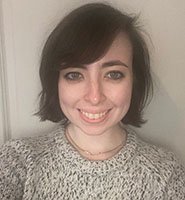
Liz Adair
Bitter City Babel
Liz Adair received her B.A. in English from the University of Alabama in 2016 and her MFA in Creative Writing from McNeese State University in 2020. Her poetry has been published in Strange Horizons and diode poetry journal. Her fiction has been featured in Creepy podcast and Morrow Point. -
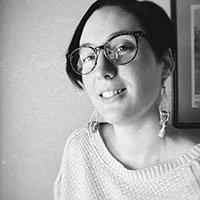
Jules Arbeaux
What the Desert Gave
Jules Arbeaux is the author of the Bath Novel Award-longlisted Lord of the Empty Isles, with short fiction and poetry in venues like Uncanny and Heartlines Spec. When not writing, Jules paints, folds increasingly tiny paper animals, and artfully neglects a throng of thriving succulents. Website: https://julesarbeaux.com/ -
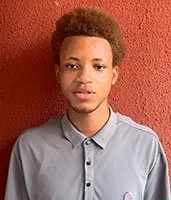
John Bekeh
My True Feelings
John Bekeh is a writer from Nigeria, who creates speculative poetry and fiction. His stories explore alternative worlds, surrealism, and cultural heritage. He is currently working on his debut novel. When not writing, John enjoys drawing, painting, and reading. -
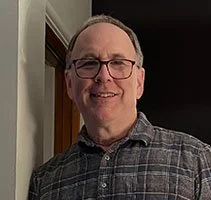
Craig Borri
Doing It Right
The author, whose most noteworthy feature is an uncanny resemblance to Chevy Chase, is an old software engineer with four kids, one wife, one grandson, and one somewhat annoying dog. His life is boring enough that he'd much rather write stories than biographies about himself. -

Tamara-Lee Brereton-Karabetsos
Systemic Empathy
Tamara-Lee Brereton-Karabetsos is a maths and science literacy writer based in Athens, Greece. She has a background in medical and health science. She has been published both in print and digital.
-

Tushar Sen
The Pied Pipers
Tushar Sen is a finance professional who also engages in sustained creative and scholarly writing. He is the author of Pandora’s Box, a collection of short stories available. In 2020, he wrote and produced the short film Zulfi, which screened internationally and received 22 laurels across film festivals.