
Blood may be thicker than water, but not by much.
-
Our boat bangs on the walls of the city
river. It bangs to draw the attentionof the white Tee-shirted woman, busy
with gear on the quay. She stops to mentionher father who’s in a circus playing
in Italy. Cargo ready to bedelivered in a warehouse that’s trading
with far off countries. From the quayMust get together some time ? Her face bright.
I nod in bewilderment, Is it time ?It’s time to sail out of the filthy site.
Learn to be a captain, I reach up, climband nervously ask, What is wrong with now ?
Her light hair gleams, hands kit into the prow. -
They don’t tell you that you follow the body. Mama had me cremated and then gave little bits of me away. Where my ashes went, I went.
She kept me in an urn perched atop the fireplace mantel. Papa tossed me up and down our favorite forest trail, which was nice; I was worried I’d never get to walk that again. (I can’t go more than a few feet from the ashes, you see.) Bud, my best pal, took me up our mountain and threw me into the wind. Lila, my girl, scattered me into the stream where I had asked her to marry me. Some of me settled into the muck at bottom. And some of me, as years went by, flowed all the way to the ocean, where I could swim around and see the fish. I found that sort of neat, all things considered.
So that was my life — or my death, rather. Jumping between my ashes, glimpsing the ones I left behind.
I visited Mama the least. Not because I didn’t like Mama. The opposite, really: I loved Mama so much that seeing her sitting in her rocking chair, gazing emptily out at the trees, day after day … why, if I wasn’t already a ghost, I’d say that it killed me every time.
Papa hiked our trail every Sunday. He was quiet, yes. Real quiet. Not much different than when I was alive. However, lately that quiet seemed a little more peaceful, at least.
Bud used to climb our mountain every month on the anniversary of my passing. I’d pop over to the summit at noon and there he’d be, eating our favorite sandwich: banana and peanut butter. I’d sit next to him until he descended. That was the first few years. Now he climbs it only occasionally, maybe every six months or so. But a few summits ago, he brought his gal. And this past climb, he had a baby strapped to his back. That would have made me cry, if I could.
Mama and Papa’d be gone for long stretches, sometimes, and that was very lonely. But they always came back with smiles on their faces, until Mama settled back in her rocking chair and Papa went to tinker around in his shed. I hoped they did something worthwhile in those stretches. I hoped they took a cruise or backpacked around Europe or did any of the other crazy things retired parents should do.
My girl did not keep any of me for herself. I would not mind, if I did not ache to see her every second of every day. I thought she might visit Mama, but no luck. Maybe she moved on. That did not bother me; I still visited her in memory every moment I could.
Round and round I went between these places, hiking with Papa on Sundays.
Seeing Mama when I could bear it. Watching Bud become the man I wished I could be. missing Lila with every dead cell of my spectral body.
And then, one day, I felt a tug.
It was different, this tug. I’d always feel a little nudge when someone or something touched my ashes, like the fish that gave me a nibble, or when Mama carefully lifted my urn for just a second so she could dust. But this tug was different. This hurt.
It pulled at my midsection, so uncomfortable that for a moment I wondered if I had come back to life and been punched in the stomach. I closed my eyes and followed the tug, jumping through space and shadow to my ash location.
There stood a little girl, tossing sand into the air. My eyes zeroed in on my ashes there. What a curious thing, for them to end up on the beach. I suppose they would eventually.
I smiled at the little girl, and then scanned the beach. Where were her parents?
Then there she was.
I froze, just staring at her, olive skin, dark hair down to her waist.
I marched right up to her, nose to nose, desperate now. I would know those warm, brown eyes anywhere. It was her. It was her.
With subtle wrinkles now, and stronger laugh lines. How long had it been? Seven years. Seven years and Papa still hiked that trail every Sunday, Momma still sat in that rocking chair, Bud still climbed that mountain.
How could it be? My ashes, tossed into that North Carolina stream, washed into the ocean, swirled up onto a beach that had to have been at least a couple hours away from home ….
“Lila,” I breathed, and for a moment, she looked up, and my dead heart might’ve thudded a little — until I realized she was looking at the girl.
“Max, what did I tell you?” she called. “That’s too close to the water! Come over here.”
The little girl sighed and trudged back to Lila. “Why couldn’t we go to our normal beach?”
“I don’t …” Lila’s eyes glazed over, and then she gave her head a shake. “I don’t know, honey. I just … thought we should come here.”
The little girl paused and tilted her head before saying, “A daddy feeling?”
“A daddy feeling,” Lila confirmed quietly.
I jolted and looked at Max properly.
Hazel eyes.
I knelt down next to her, breathed her in, this four-foot little thing with my eyes and Lila’s hair and Mama’s freckles splattered across her nose.
And that little girl looked right at me. Not through me — at me, I know it. Right into my eyes. Hazel on hazel.
A daddy feeling.
Then she looked back at Lila. “When are Gramma and Grandpa gonna be here?”
Lila looked at her watch. “Couple of hours. Bet that’s enough time for me to make a bigger sand castle than you.” Lila suddenly ran along the beach toward the damper, more malleable sand, shovel in her hand. Giggling, Max sprinted after her.
A light bulb went off on my head and I jumped over to the house, to my ashes with Mama. Rocking chair empty. Lights off.
Grandma and Grandpa. Therefore, that was where they went on their long stretches. I almost laughed aloud in relief.
There was my girl, and our girl, and Mama and Papa were on their way.
The presences of my ashes that I always felt in my body, suddenly stilled.
The presence from the mantel, the trail, the mountain and the stream. In one moment, they were there and the next, they had coalesced into a single, warm push, a gentle and most curious hand upon my back.
I smiled as I watched my girls play in the sand. Then I walked into the waves, toward the setting sun.
-
Here we are, we're
Floating motes in the moonlight, no
Better than strangers
Brownian motion moving closer to
Something the stars call love
And I’ve only entropy for you.
If there’s one thing we know
It’s that we’ll be stuck following the
Outlines of thermodynamic rules
Drifting toward heat dissipation and
Falling further away from each other, so
Here’s what I’ll do
Spend this freefall dreaming of you and I. -
“I don’t like him, Mama,” Ava mumbled, and Mama turned and knelt next to her.
“Darling,” she said, but it wasn’t her soft Mama voice, it was her hard Mama voice and Ava felt bad in her tummy, “it doesn’t matter. You will pay deference.”
“I don’t want to,” Ava whined. Ava was used to getting her way most of the time. But the first time she tried to pull away from the Patriarch, Mama slapped her. She didn’t want to be slapped again, but she also didn’t want to see him again. He was creepy.
“Sometimes we must do what we don’t want,” was all Mama said.
“Do you want to see him?” Ava asked. Maybe it would be easier knowing Mama was with her and Mama also thought he was creepy. And so, so old.
“Depends on what kind of want you mean,” Mama said and this time her voice sounded weird and empty. Ava frowned.
The door into the Patriarch’s Wing beeped and Mama pressed her card to the entry lock. Mama took Ava’s hand again and pulled her forward down the hallway.
“Esme,” nodded one of the workers. He was dressed all in white, wearing a big bulbous lens over his eyes that made him look like a lamp.
“Hello,” Mama said distantly.
“He’s just gone down for a nap, but we can tell him you came by,” said another worker. She, too, was dressed all in white, but she didn’t have one of the lamp lenses over her eyes because she didn’t have eyes; they’d been replaced with diamonds. The last time Ava was down here, Mama told her not to stare at them, so she looked down at her hands.
“We’ll sit with him for a little while in case he wakes up,” Mama replied.
That would mean a longer visit. “Mama,” she whined but her mother’s hand tightened in hers.
Mama’s eyes darted between each of the workers. “She needs a restroom. Perhaps she can use one before we go in.”
The worker nodded and a moment later, Ava was shoved into the bathroom.
Through the door, Ava heard, “His vitals are strong,” from the worker with diamond eyes.
“Good,” Mama replied. “Will there be any issue with the transplants next week?”
“None foreseen,” the lamp-lensed worker informed her. “He should survive the procedure to the Estate Taxation’s satisfaction. No need to worry about his assets.”
“I’m not worried,” Mama said, though she sounded worried to Ava. Then Mama knocked on the door. “Ava, are you done in there?” Ava flushed the unused toilet and hurried to the door, opening it and stepping out. Mama took her hand again. She wondered what an asset was. People always talked about the Patriarch’s assets and how much they’d grown throughout his enduring life. But the one time she’d asked, she’d gotten a when you’re older. Usually a when you’re older was a relief because when someone said it, it had something to do with money or the government and those were boring. But this time, Ava wanted to know. Everyone made it sound so important.
Mama did not knock on the Patriarch’s door. She led Ava straight in, down the plush carpeting that the Patriarch never walked on and sat them down on a sofa next to the Patriarch’s bed, lined with beeping contraptions.
The Patriarch was breathing, though his eyes weren’t open. Ava was glad about that. The diamond eyes were bad enough, but they’d given the Patriarch new eyes the year before she was born and they did not fit his face. Nothing did. His lungs weren’t his, his heart wasn’t his, his eyes weren’t his—even his tongue had been replaced.
“Mama?” Ava asked softly, and her mother leaned her head down. “Will I have to be replaced to live forever?”
She flinched, preparing for another slap, but this time, it was soft Mama voice. “No, darling. The Patriarch lives forever so we don’t have to. His abundance sustains us, and no one can take it away.” She reached out and straightened the blankets over the Patriarch’s thin chest the way she tucked Ava into bed at night. The Patriarch’s breath rattled in his throat and Ava shivered, though she wasn’t really cold.
Ava peeked back at the Patriarch. His paper-thin skin barely hid blue veins. He could barely sustain his own life, much less theirs. “What happens when he dies?” she asked, picking a bit of skin peeling away from her thumbnail.
Her mother’s voice was cold as a slap. “Don’t say things like that. You don’t want him to die.”
“No!” protested Ava. “No, I don’t want him to die. But he will, won’t he?”
“No, he won’t,” her mother growled. “He can’t die. We won’t let him. The family loses everything if we can’t keep him alive. You’ll understand when you’re older.” Mama cleared her throat, and when she spoke next, it was throaty and musical. “We thank you for all you give us, Patriarch.”
She said those words every time she brought Ava to see the Patriarch. They were the same words she said her own Mama taught her. She leaned over and whispered into Ava’s hair, “It’s your duty to respect his sacrifice for our family. Be a good girl.”
Ava squared her shoulders and made herself look at him, at his skeletal face and his liver-spotted skin. She cleared her throat, and though she wished the words didn’t come out quite so wispy, she did manage to say them. “We thank you for all you give us, Patriarch.”
-
My mother never saw the sun.
Her world was always frozen tight,
from day’s half cut by horizon.
My father thrived beneath the light.They met in gradient of twilight:
my mother never saw the sun,
my father thrived beneath the light,
yet in the dusk they bore a son.Of life together they’d have none —
my father thrived beneath the light;
my mother never saw the sun —
though joined, they crafted something bright.My father thrived beneath the light.
But night and day’s brief unison
cannot a severed world unite.
My mother never saw her son. -
My soon-to-be-ex-husband and I had agreed to meet at the African Diner on the corner of 63rd and 2nd to finalize our divorce papers. There would be no lawyers, no courtroom, and no open hostility — just the two of us signing on dotted lines, equitably sharing our assets and a plate of spicy lentils spooned over injera.
Or at least, that was the plan until I looked up and saw myself walking through the door of the restaurant behind my could-not-be-ex-soon-enough-husband.
He ushered her into the booth across from me and slid in beside her, grinning like a cat with a spider in its mouth.
“Jordyn,” he said to me and then to her, “I’d like you to meet Jordyn.”
“You cloned me,” I said. It was very much a statement and not a question — he could hardly deny that the woman fidgeting with her menu on the other side of the table was an exact copy of me, only a decade or so younger.
“I did,” he said. He turned his attention to the menu in front of him. “What do we think about an order of fried plantain for the table?"
“I never authorized her creation,” I said.
“Oh, but you did.” My should-have-been-ex-much-sooner-husband pulled out the manila folder of documents he’d brought with him and selected a paperclipped sheaf of papers from the middle of the stack. He slapped it down on the table in front of me with the flourish. “It’s right here.”
I scanned the familiar document. “This is our pre-nup agreement.”
“Turn to page sixteen.”
I flipped the pages and found the relevant paragraph wedged between a subsection on goldfish custody and a section concerning ownership of our shared waffle iron. My should-never-have-been-husband had already highlighted the relevant sentences in poison-frog-pink, presumably in anticipation of the argument we were about to have.
SECTION 28.6.3 - CLONING RIGHTS
In the event that wife JORDYN SYZMANSKI is rendered permanently unavailable to husband ETHAN WICKLOW, wife JORDYN hereby authorizes the creation of an age-accelerated biological clone of herself, deliverable to husband ETHAN. Wife JORDYN hereby agrees to provide a biological sample to be held in indefinite cold storage at an EASTERN REJUVENATION SERVICES facility.
I smacked the page a little harder than I meant to. “This only means you can clone me if, like, I died or ended up in a coma or something.”
“Doesn’t say that though, does it?” asked Ethan, taking the paper out of my hand. “It says ‘is rendered permanently unavailable’. You made yourself permanently unavailable to me when you walked away from our marriage instead of dealing with our issues like an adult. That’s fine, you’re entitled to do that. But that means I’m entitled to a replacement.”
I was about to string together a collection of curse words that would almost certainly have gotten me ejected from the restaurant, but I was interrupted by the appearance of our waitress.
“Have you had a chance to decide?” she asked, her finger poised over her tablet.
Ethan ordered the mixed Ethiopian family platter and a basket of fried plantain for the table. Neither of us Jordyns said anything. When I was the clone’s age, I’d thought it romantic that Ethan liked to order for me, and at my current age, I was simply tired of arguing with him.
As soon as the waitress was out of earshot again, I leaned across the table toward my so-soon-to-be-officially-ex husband.
“You couldn’t join a dating network like a normal person?” I hissed.
He smirked and slung an arm around Young Jordyn’s shoulders. “Not my style. I made a vow to marry Jordyn Syzmanski, and I intend to stay married to Jordyn Synzmanski, even if it means I have to order myself a new Jordyn Syzmanski.”
The clone allowed herself to be pulled into Ethan’s side, but she bared her teeth in an expression that others might mistake for a smile, but that I recognized as the face I made when I was desperate to find some polite excuse to leave a party. I found it hard to look directly at her; watching her movements felt like watching an old home video that had been taped without my knowledge.
“And how do you feel about this?” I asked, addressing her for the first time.
Ethan answered for her. “She feels exactly the way you did at her age. She’s hopeful. She’s fun. She’s excited about being my wife.”
There wasn’t much that Ethan and I agreed on at that point, but he was right about one thing: at the clone’s age, I had been excited about marrying Ethan Wicklow. We’d met at university, where we’d whispered back and forth for hours on the quiet floors at the library and proofread one another’s term papers over 2am baskets of onion rings at the 24-hour diner on the corner. Ethan the Boyfriend had been gentle and thoughtful, the kind of man who walked an extra three blocks in the rain to bring me falafel from the good falafel place the night before my biochemistry midterm.
But then he’d been Ethan the Husband. And, as I’d come to realize over the course of a decade, Ethan the Husband was a terrible, selfish, controlling, unpleasant, naval-gazing bore. The man who’d once recited poetry beneath my dorm room window had grown into a man who let groceries melt on the countertop and let the wet laundry collect mildew in the dryer, even after he’d told me to get off his back with the nagging because he promised he’d get to it. He’d forgotten my last six birthdays and turned our last three vacations into full weeks of complaining about everything from the hotel check-in procedures to the colour of the towels I’d packed for the beach. When the courier had pressed the divorce paperwork into his hands, he’d rolled his eyes and called me dramatic before shuffling back to his home office.
Our waitress returned to the table with our food, and we paused our conversation while she identified each of the curries and stews spooned onto our injera platter.
“What makes you think this time is going to be different?” I asked Ethan once the waitress had walked away.
He toyed with a lock of the clone’s hair, which had not yet developed little threads of silver at the temples.
“The age gap works better for me,” he said, taking a pinch of misir wot with his bread. “We were the same age the first time around, I couldn’t really be that strong leadership presence you needed. By the time I’d grown into being a leader, you were too headstrong to be led.”
I snorted at that, and my clone turned to face Ethan.
“I don’t think two people have to be the same age to be equal partners,” she said. It was the sort of thing I said at her age, when Ethan the Husband had begun to appear. I noted, with some surprise, that the clone’s voice sounded the way my voice sounded in recordings, and not the way it sounded in my own head.
Ethan made a non-committal noise in her direction and wiped lentils from his mouth.
“I won’t make the same mistakes with her that I made with you,” he said. “I’m not the broke college student you married. There’ll be no need for her to work jobs with all those long hours, and there’ll be no bothering with all those fertility treatments that never worked. She’ll focus on our marriage, and we’ll be happy.”
“We’re not having children?” the younger Jordyn sounded surprised.
Ethan shifted toward her, and I knew without seeing that he was patting her thigh under the table. “You can’t have them naturally, honey. It’s just not in the cards for you. I tried for years with the old Jordyn, and all the fertility treatments ever did was waste my money and make her bloated and cranky. We’re not going to go down that road with you. Trust me, we’ll be happier that way.”
The clone reached for a bite of goat curry, and I was struck by how easily I could read her familiar gestures. The slight moment of hesitation as she reached for the goat curry might as well have been a 14-page dissertation on how uncomfortable she was feeling in this interaction.
“Well, good luck with all that,” I said, and I wasn’t quite sure who I was speaking to.
We ate the rest of our meal in silence, save for the sounds of Ethan and I passing our divorce papers back and forth and pointing out all the places they needed to be signed, dated and initialed. We had no children and our ironclad prenuptial agreement had made it clear from the beginning that we would both walk away from the marriage with whatever we’d each carried into it.
We were just about done with the signing when Young Jordyn picked up another roll of injera, and Ethan touched her forearm.
“I’d go easy on the bread,” he said, and nodded in my direction. “Those carbs will start adding up sooner than you think.”
“You know what? Go to Hell, Ethan,” I said. I stood and tossed the stack of papers next to his plate. “There’s the last of it. Try not to forget to file it.”
“Oh, I won’t,” he promised. He held up another sheet of paper with the words APPLICATION FOR MARRIAGE LICENSE at the top. “Have to finalize the divorce before I can file this, after all.”
“Great. Have a nice life,” I said to them both. And I walked out of the diner, positively giddy that I would never have to see my finally-for-real-ex-husband ever again.
* * *
It was a little after one o’clock in the morning when I opened my front door the following spring to find myself standing on my doorstep. Younger Jordyn had watery raccoon smears of makeup under her eyes; somewhere in the back of my brain I noted that she was wearing the same deep purple mascara that I had favored at twenty-five, even though it had now been out of style for a decade.
“Yeah, he’s awful, isn’t he?” I asked. She swiped at her eyes as she nodded, leaving streaks of purple across her nose.
“I’m sorry, I didn’t know where else to—” she started, but I shook my head and held open the door.
“Come in,” I said. “I’ve been waiting for this. I set up the guest room for you the day I met you.”
I directed her to the shower, which was already stocked with an array of products perfectly suited for her skin and hair. She crept out to the living room afterwards, wearing a borrowed pair of my pajamas that fit a little looser on her, and sat down crossed-legged on the end of the sectional couch.
“Feeling better?” I asked, and she nodded.
“The shower helped,” she said. Then she hung her head, hiding her face behind a curtain of wet hair.
I sat down beside her. “Out with it.”
She stared at me.
“I can tell there’s something you’re not saying. I’ve been ‘you’ a whole lot longer than you have,” I told her.
She sniffled. “I feel… pointless, I guess. I’m a clone of you. An exact copy. I really felt like I could be my own person, but I’m not – I was created to be a replacement for you, and then I went down exactly the same path you did, and everything fell apart exactly the way it had for you. I don’t feel like a real person. I can’t live your life, and I can’t make my own.”
I got up and filled two glasses of red wine from a bottle sitting on the counter and carried them to the couch, handing one to her.
“Honey, you might be made from my genetics, but I promise you, you’re not a copy of me.”
She looked confused. “What do you mean?”
“Well for starters, you’re a whole lot smarter than me. You left that rat bastard nine years earlier than I did.”
That got a smile out of her. She swirled her wine in her glass, and I noticed a small cat-scratch scar on her wrist that I didn’t have.
“So what now?” she asked.
“Now you do what I never could,” I said. “You live your life without him. And you do whatever the fuck you want to.”
I clinked my glass against hers, and we smiled identical smiles.
-
to hold grudges
tighter than your
mother’s hand,
looking both ways
as you cross the street
hopping over every
crack because her
back is already
breaking from
bending to your needs
just get over it
already, you can
see begging in
her eyes, just
forgive and let be
but there’s still
glass in your tear
ducts and rips
in your palm lines
all your cuts bleed
if you stretch yourself
long enough for a
view of a future
that hasn’t woken
you with a scream
you are still hers
but you are not
a child so you take
a path she can’t find
her hand you release
holding tighter to
your grudges and leaving
forgiveness ungiven,
not looking out for cracks
as you walk your own street.
Meet Our Contributors
-

Marie Brennan
Horizon’s Child
Marie Brennan is the Nebula and World Fantasy Award-nominated and Hugo Award-winning author of the Memoirs of Lady Trent, other fantasy series, over a dozen poems, and nearly one hundred short stories. As half of M.A. Carrick, she’s written the Rook and Rose trilogy. Find her online at linktr.ee/swan_tower. -
Jason P. Burnham
What I’m Thinking Of
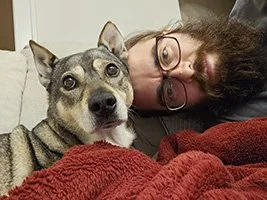
Jason P. Burnham (he/him) loves to spend time with his wife and children. He dearly misses his dog. -

Janel Comeau
Once More, With Feeling
Janel Comeau is a writer, illustrator, comedian and youth worker currently residing in Halifax, Nova Scotia, Canada. Her work has been nominated for Best Small Fictions, and has appeared in Haven Spec Magazine, Write or Die, Ink in Thirds, and several other fine publications. -

Mark Lawlor
Quay
Mark Lawlor won a Hawthornden Fellowship (2021). He recently was one of the prize winners in the International Competition for Nature Writing run by the moth and judged by Kathleen Jamie. -

Odi Welter
Too Old Now
Odi Welter (they/she/he) is a queer, neurodivergent author raised in Minnesota and living in Milwaukee. Their first publication was an obituary– which should make him way more emo than she is– and since then their creative work has been published in many journals and anthologies.
-

Celia Winter
Long Live the Patriarch
Celia Winter’s writing has been published in Plott Hound, Heartlines Spec, The Dark Magazine, and several anthologies. She lives in Chicago and works in Analytics. When not knitting, she can be found writing; when not writing, she can be found bothering her two fluffy cats.
-

Souad Zakarani
From Ashes to Ashes
Souad Zakarani is a highly decorated Moroccan poet, writer, and translator.
Her short stories and contemporary poems have been published and highlighted in Germany, notably several times in anthologies produced by the esteemed Brentano-Gesellschaft in Frankfurt.
Additionally, she has been featured in German-focused literary and migratory publications like Words and Worlds Magazine. Her poem “Weiß” was shortlisted for the prestigious Ulrich Grasnik Lyrikpreis. She earned Honorable Mention in the internationally recognized Stephen A. DiBiase Poetry Prize competition.
She was awarded the Second Mention for her poem “Aceitunas de Gaza” at the Fray Bentos Poetry Contest, a notable competition in the South American region. Naji Naaman Literary Prizes’ 24th picking Season for her poetry collection “Deep whispers.”
Her poetry, essays, and short stories have been widely featured in international journals, including WELL READ Magazine, Lothlorien Poetry Journal, and the #CaptureThis Anthology.
She is a highlighted author in Spanish platforms such as the Critica No Especializada and the literary journal Revista Innombrable.