
-
Finn recovered quickly after his buddy, Ted, wrapped his car around a tree, but his legs still hurt on those long nights he spent on his feet. This was his first job, and he really enjoyed it. It was important work, too. He worried, however, when he wasn’t at home. Most nights, Mom was passed out on the couch. Someone needed to make sandwiches for Casey’s and Sela’s school lunch and check their homework before bed.
He ran the carousel at a carnival that never left town. He calmed uneasy children who drifted out of the dark mist, coaxed a little laughter out of them, then gave them their best night ever. Tonight, his little passengers kept him waiting by the arched gate. Finally, three children emerged from the fog, and he welcomed them inside. One was a thin, bald little boy in pajamas, his skin yellowed from rounds of chemo. Next came a girl with blood on her shirt, her limbs broken and bent at weird angles. She tottered along without any help from Finn. The third boy, no more than five years old, dragged a huge suitcase behind him. When Finn tried to take it, the little guy cried, “No, this is my bed.”
“A suitcase isn’t a bed,” said Finn.
“Yes, it is. I been sleeping there for days and days.”
Finn winced. This one hurt, but he was about to make everything okay. “Your bed might get broken on the merry-go-round. I’ll hold it for you. You can get it when you finish the ride.” The child would never come back for it.
He led them to a corridor ablaze with colored lights that stretched forever into the distance. Smells of hot dogs and fried dough wafted everywhere. The carousel was spectacular. Every kind of animal was there, brightly painted: dinosaurs, horses, teddy bears, wolves and more. Three little mouths dropped open in awe as they pressed forward. “You don’t need a ticket,” Finn told them. “Go around as many times as you like. Get off when you’re ready.”
He let them take their time choosing their mounts. He didn’t ask their names. The smallest kids often couldn’t remember and got upset if Finn pushed them. They would tell him if it was important. He figured Chemo Boy would choose something imaginary. Children like him loved magical characters. He climbed aboard a purple dragon. The girl chose a swan–something that would glide rather than bounce up and down. Suitcase Boy took a black horse stretched out in a full gallop. Finn understood. In the child’s imagination, he was racing far away from everything that scared him. “Gone in four trips,” he predicted.
Before he started the ride, he found the girl who had chosen the big friendly dog two days earlier. No one had ever ridden that long before. Her little, white-knuckled hands gripped the pole like they were glued. She wore a weird grin, teeth clenched like her jaw was wired. It wasn’t. Finn could almost hear some big, scary adult screaming, “Goddammit, you smile when I tell you to smile.” By the end of her first night, she trusted Finn enough to whisper her name: Violet. Her jaw relaxed just a bit when she saw Finn approach, but she flinched as he patted her mount.
“I can’t tear you two apart, Violet,” he said. “Having fun?”
He saw fear in her eyes. She was trying to think what the safest answer would be. “It’s okay. You don’t have to tell me,” he said. He hopped off the carousel, started it up, then jumped aboard again. He mounted the horse next to Violet. “I want to show you something cool. Look at how the lights all run together as we go by.”
Violet’s eyes flicked away from the pole, then to Finn’s face. The grinding teeth parted slightly. “Pretty rainbows,” she said.
“Now watch me.” He threw his arms wide as the ride whirled faster and faster. “See? It’s even more fun when you let go.”
Something close to a giggle leaked from her throat. Finn grinned and went around with her two more times. He dismounted and watched as his passengers flew by. Three times around and Chemo Boy was gone. The happy ones always left quickly. After four turns, Broken Girl raised a crooked arm and waved. By the fifth time around, she vanished. Meanwhile, Suitcase Boy extended his arms, crying, “Look at me! I’m flying.”
“Yes, you are,” said Finn. Then that little guy disappeared, too.
That left Violet. He waved every time she streamed past, shouting to her, “You’re doing great.” Then, miracle of miracles, she let go of the pole, her hands resting on top of the dog’s head. On the next pass, Violet raised her arms. Her mouth relaxed into a big open-mouthed smile. One more round, and the carousel was empty.
“Mission accomplished, Finn,” said a voice behind him. “Boss says it’s your turn now.”
He turned to find a girl about his age standing behind him. “Why? Am I fired?”
“You got promoted.” She extended her hand. “My name’s Beth. I’m your replacement.”
“But you don’t know . . .”
“I know what you know.” She lifted her shirt, exposing old cigarette burns someone had branded her with years ago.
“I can’t go yet. I’m waiting for Casey and Sela.”
“Your sibs? They’re not coming.”
“Why not?” Finn’s eyes filled with tears.
“Honey, they’re all grown up. They have families of their own.” Beth nodded toward the carousel. “Boss says you were fantastic. Now you get a turn.”
He nodded and smiled, then took a running jump as the platform whirled past. He’d always liked the wolf. It was kind of metal. As he swung his leg over the saddle, Beth called to him, “Remember, it’s more fun if you let go.”
-
She takes her heart out of her chest and drops it in her cup of tea. The milky-biscuit liquid doesn’t change colour at all. Heartsblood is invisible, as everybody knows.
She exhales a few times, trying to fill the ghost-grey hole in her chest with breath, but it fills instead with ghost-grey memories. Something is gnawing in the pit of her gut. Intestines knot. She stretches forward, into something vaguely resembling exercise, but lacking both the dedication and grace. Static electricity in her forehead crackles. She turns her mindseye to those ghost-grey memories.
***
In her mindgut-heart she sees a staircase. It is halfway up a wall. Halfway up a ruined wall inside a ruined building. The upper walls are thick with ivy.
Gut knots. She steps closer into the memory as if it were a photograph. Silken-silver wraps around her. Like being submerged in chemicals, the memory starts to take a form.
A pigeon rustles in the ivy then flies up towards the sky. This is a monochrome world, hidden behind a Wratten sunset filter. Polarised clouds. The sun a star-like point, cascading symmetric rays. Each one at a 35˚ angle.
“Hello?” She calls, into the centre of the memorygraph. Her words echo – that doesn’t make sense. The ruined walls only reach halfway to the sky. There isn’t enough raw stone for the sound to echo off. Besides, she thinks, you can’t Doppler-shift selenium.
Then: stop trying to be clever. Then: take a walk around.
***
A tall middle-aged man in a hard hat is leading a tour group. Investors, directors, press officers. “Here we stand,” he gestures, “in what used to be the kitchen. Back in 1708…”
She sighs and walks away, leaving the investors, directors and press officers to their lecture.
There is a forest behind the ruins. It is also behind a rusty fence and rusty barbed wire. Signs say, no trespassing, and trespassers will be prosecuted, and even, trespassers may be shot.
Nevertheless, she trespasses.
***
She knows the secret way into the forest. Her childhood deepmap. North-north-east, then along the farmer’s track, then sharp south back through a rhododendron grove. This is where, as a child, she made her dens.
This is where, as a child, she saw her first fawn – wide-eyed and terrified, cross-legged in the long grass. This is where it looked up at her, and she reached down to it. This is where it froze and then bolted, bounding off into the forest.
This is where she heard her first ever gunshot.
This is the grave of the shotgun cartridges.
This is also where she saw her first rabbit snare, and — metres away from the snare — her first rabbit dead from myxomatosis. First time she saw her father – the tall man in a hard hat leading the investors – take a rock and spare a creature its suffering.
There are other memories, too, beneath the rhododendron grove. Mostly bad. This is where she ran to when she ran away. This is where she dragged her friend to, when she forced her to run away. Two eight-year-old girls, hiding out below the silence. Then they slipped off out of the shadows, into miles of time.
Other memories still. The dogtooth trousers, ripped at the seam. The twist of barbed wire, the sound of a shout. The sound of broken promises, of tilled-earth curses.
Every second spent in this forest was an act of trespass.
***
“I’m tired,” she says. “I want to go home. I don’t want to see any more ghosts. I’m tired of this past, these beechwood whispers. I’m tired of the fairy glens and bent-tipped needles.”
Her gut-stomach knots again, and she exhales. She pulls herself back out of the amber-grey and back into the present, where her lukewarm teacup is still filled with her heart. She has only taken a few sips and the gap inside her roars with skeletons.
“I still need to fill this hole in my chest,” she says, to no-one.
Inside the hole, the skeletons dance. She thinks they must be having a tea party.
***
We did that, once, the skeleton says. Do you remember? Do you remember how we danced in the darkness, beneath exposed brickwork, tripping over exposed wires and tubs of lime mortar?
Her gut-knot says: oh yes, I remember.
And do you remember how we used to rollerskate upon the concrete? As if we were normal children? As if we were playing?
Yes, she answers. And I was always ashamed because I couldn’t move in inline skates. Same with the Great Pogo Stick Experiment. The concrete floor was so hard and bumpy. I was always afraid I was going to fall.
Years later she’ll wish she had a Tarmac childhood.
***
There are ghosts, though, and they do want to talk. They haven’t seen her in such a very long time. Some twenty years, she thinks. Twenty years since I last snuck into that forest, or got burned by the ivy, or ran my fingers over sandstone walls and granite graves.
The ghosts want to sit in the plastic lawn chair up on the third floor. The later third floor, when there was a third floor and not empty-air ruins. When the staircase led to somewhere else, not the bare halls of Hades or some other dimension.
Twenty years of a city life, she’s lived. Twenty years of winding rivers, thumping bass, and open secrets. Twenty years without the stars, without cold air. Even the frost-driven snow-slush woollen-wrapped winter streets aren’t cold, she knows. Not like those dark Scottish winters.
Not like the ghosts of haunted paintings. The painting of the woman in the snow. The painting of the woman whose eyes follow you around the room. The painting of the woman whose left hand folds over the right on one morning, but whose right hand folds over the left on the next. The painting of the woman who steps backwards in the snow, never letting a flake touch the hem of her skirt. The painting whose little dog sometimes appears in the lower left corner, and sometimes in the right.
No. There are no winters like that in the city.
***
She has half-finished her cup of tea. Her teacup heart is half drying out.
***
There is an underground car park between the swimming pool and the laundry room. It is a cavernous monstrosity of private parking, chock-full of Mercs and Beamers.
She walks across it, hearing her memoryfeet echo on the concrete. There is colour, here. The pillars of the car-park are painted the pallid hue of Dijonnaise. The finest quality Dijonnaise.
She walks quickly, very quickly, to the other side.
***
Tenement buildings. The kind where artists and writers live. The kinds where people choose to live when they choose to suffer for their art.
Let’s not stop here, she thinks. Let’s return to those dark swathes of ivy.
***
But the ivy is too noisy, too busy. There are oh, oh so many ghosts. So many fans, so much clamour. She has too much of an urge to climb up those forbidden stairs, those impossible stairs, suspended halfway up the walltower. Oh how her innerghoul child wants to run up those stairs, disappear into the cloudlands or the demon-fires that lay behind them –
-and how she thinks of the ladder, once, that stood propped up against that wall, so close to those forbidden stairs, so tangible. And how she thinks of the ladderman, who turned to her and smiled, and then he fell, fell, fell down to earth with a crack –
-and how now the ladderman is too a ghost, standing tall and strawberryblond in this his ghostlight, smiling down at her, telling her it’s not too bad to be a ghost, telling her it was never her fault and she must never feel guilty and he is at peace, like all the other ghosts here, the other ghosts who call so loud and jostle and smile and reach out to her after so long, so long…
***
There’s a full moon above the chip shop, the City Wrapper. Because music is forbidden, she doesn’t get the joke. There are wire grates and broken glass and gunshot wounds and slashed tyres here. But she doesn’t dwell in this smoke-solid ghost city. You can’t Doppler-shift selenium.
***
The mug is empty. Her heart looks sad, not to mention endangered. She takes it out and puts it back in her chest. The ghost-grey hole is plugged, for a while. But she knows it won’t last. It might be small enough to fit in a teacup, but it’s far too big to be locked up in her chest.
-
you never halted unearthing where the light was dread to fall
shearing my garden inside out for the umami of inhumed sin
shovel slid in like an admirer then broke like a blade in bone
i fed you dirt & you wolfed it down, reminiscing it was verityshearing my garden inside out for the umami of inhumed sin
you pulled up skeletons that hadn’t even wrapped up dying
i fed you dirt & you wolfed it down, reminiscing it was verity
while the worms penned amour letters i’ve never dispatchedyou pulled up skeletons that hadn’t even wrapped up dying
your mouth stuffed of monikers you couldn’t have known
while the worms penned amour letters i’ve never dispatched
you barked the earth moaned when you pressed your weight inyour mouth stuffed of monikers you couldn’t have known
burrowing past roots to stumble upon thirst under stone
you barked the earth moaned when you pressed your weight in
humus tasted like rust haemorrhaging from senescent gashesburrowing past roots to stumble upon thirst under stone
i gazed upon bloodied flowers sprung away from your hands
humus tasted like rust haemorrhaging from senescent gashes
bones fissured under your sleek fingers like friable promisesi gazed upon bloodied flowers sprung away from your hands
shovel slid in like an admirer then broke like a blade in bone
bones fissured under your sleek fingers like friable promises
you never halted unearthing where the light was dread to fall -
My mother-in-law hears about the promise shop from the ginjinha man. She brings us three cups of blood-red liqueur from his cart and announces we will be heading there next. I remind her I’m not interested in promises, wax or otherwise.
“It’s my vacation too,” she says.
“No,” I tell her. “It really isn’t.”
Then, for the third time in our nine days in Portugal, she begins to cry. My husband, Manny, moves quickly to comfort her. It’s not that I don’t care. This is hard for everyone; I know. I simply have not accepted the fact she is here, on the last trip I will ever take with my husband. Manny’s primary concern is, as it has been the past eighteen years of our marriage, Dona Isabel’s comfort. He says the shop is the least we can do, since I refuse to attend mass or make the pilgrimage to Fatima. With his arm still around his mother’s shoulder, Manny guides us through the narrow, cobblestone streets of Porto to the shop. Dona Isabel needs time to compose herself. She dabs at the bags under her eyes. The whole scene annoys me, so I go inside without them.
The inside of the shop is covered, floor to ceiling, with molded wax figures. There are houses and animals, but mostly there are body parts. To my right is a neat line of forearms, elbows, knees, limbs bent and cut in every direction. To my left, I find entire babies, ears, a big stack of hollow breasts, and a disturbingly textured tongue. The promises are secured with zip ties or twine, seemingly at random, and hang on hooks dotted on the cork walls. It is horrifying and beautiful. The shopkeeper sits at a table in the center. She is a portly girl, young, but dressed much older, all in black with a thick sweater, lace skirt, and head scarf. She asks me what I’m looking for and I realize I don’t know the word.
“Gallbladder?” I ask.
The girl smiles and holds a hand in front of her body, moving it up and down, as if scanning herself. “Where is?” she asks. It’s obvious she has used this method before.
“Here, aqui.” I point to the right side of my chest, at the approximate location of the organ and the tumor within it.
The girl leads me to the back wall. This area is for internal organs. She points at a liver. “Not this?”
“No,” I agree.
The girl moves to an enlarged gallbladder, about the size of a grapefruit. I nod. Manny and Dona Isabel enter just as the girl is placing the promise reverently in my hands.
We purchase the vesícula biliar for my inoperable cancer, an elbow for my mother-in-law’s rheumatoid arthritis, and a little sheep, just for fun. The girl instructs us to leave the promises across the street, at the altar in Igreja do Carmo so the priests can burn them on our behalf. Manny avoids my eye as he translates. He knows this is everything he promised we would avoid. You said custard tarts and codfish cakes, I want to tell him, you said day drinking and no weird religious shit.
When we leave the shop, the ginjinha man is moving his cart along the street. I turn to Manny. “I need another drink,” I tell him. He argues, but his mother goes to order for me. This is the one thing Dona Isabel does not fight me on. Maybe she’s unaware I’m not meant to drink on chemo, or maybe she knows, but thinks drinking may expediate things.
I shoot the ginjinha back, then slowly gnaw on the sour cherry as we enter the church. On the altar, there are candle sticks and a head. Dona Isabel adds our promises, but as she takes a step back, her heel lands on my foot. I gasp in surprise. The pit of the cherry shoots to the back of my throat and the sound of my choking echoes violently through the church. Worshippers turn at the noise to find my husband slamming his palm against my back until the offending object is ejected.
The cherry pit has landed on the promised gallbladder, leaving a small stain that seems to spread slowly. We watch as the pit weeps, the juice consuming the gallbladder entirely, turning it red, almost black in the dim light of the church. We watch it claim the remaining promises, the head, our little sheep, and the surface of the altar itself. Manny and his mother stare at the desecration. When Dona Isabel begins to cry a fourth time, her son does not comfort her.
-
I.
This persecuted mortal coil has uncoiled.
Canvas of flesh sloughed off.
Brain stopped its idiotic quivering synapses.
Hideous heart stilled.
Skin predictably grayed. Its only animation those messily precise scrawls of tropical islands, naked women, wild animals, and dragons— five tattoo artists had tried their inky best to make me look a little more interesting.
They failed.
I’d suffered for their art; I’d suffered in life.
No matter the details: much escaped me.
Most memories evaporated with my stiffening gray matter.
Now, I would suffer no more.
II.
Brother of Five Fucks, I got that no-more-suffering part so terribly wrong.
III.
Yeah, I’m a discontented ghost— vampiric homicidal revenant.
Evil? Maybe.
I tell you this, so you understand the mean shit that’s boiling in the veins of the fool typing these words. I’ve possessed those meaty digits—as one does—when it’s time to write a little manifesto or tell a little tale.
You’d be surprised how much flash fiction gets written by a restless spirit.
Short fiction suits us. Only so much electromagnetic juice in our ethereal bodies.
We can fret forever if we avoid the gray ooze—more on that below.
To it then! Each word a murder.
IV.
I’ve killed a million.
No devils nor angels on your shoulders.
Just the burden of the angry restless dead.We’re in a race to manifest before we disappear.
There’s this drifting cosmic swamp of plasmatic gelatin that sucks us up: the gray ooze.
That’s why we keep moving.
Body and brain hopping ahead of the ooze that consumes all: we have to make a lot of sudden moves. It’s not sadism but lethal necessity: quick synaptic blasts that cause strokes and heart attacks when we jettison to the next host.
We leave a trail. Breadcrumbs that the primordial ravenous ooze can scent out.
I realized I had to cause a mass event that would make it harder for the ooze to catch up.
A macabre panspermia.
I needed religion.
V.
I found the perfect persimmon tree in the grove that this hippie cult of scientists and artists had set up—Methuselahns. Yes, the darlings wanted to live forever.
With desperate spasms of rage, I entered the sap of the tree in the Methuselahns’ grove and began an ecstatic electrical dance: envenomated the unripe persimmon’s toxic tannins, the shibuol curdled into pure death.
Sheol nectar.
VI.
Bees came and pollinated the tree.
Bees, tree, and me. Heavenly trinity.
Elixir vintners.
The gray ooze drifted across the milky way at night, so I stayed still: not a leaf quivered in the night wind. Bees, tree, and me. We conspired for immortality.
Yes, lyrical indulgence. Every prophet needs some.
VII.
Other trees shared in our bounty.
Seasons passed.
I clung on as sap dried.
Spring came. The orchard had been inseminated with our holy spirit.
Other phantoms were jealous.
They flitted about among the stars, darting at planes in desperate imitation of my Artistry—some harassing missile silos or other tools of war and apocalypse.
None could till the fields of destiny like me.
VIII.
When the botanist came to test the first fruits of the season, I could feel the ripple of desire on her lips, so I entranced her with a synapse straight to her hippocampus—a leap of faith.
She heard me whisper. “Fruits of the gods demand sacrifices.”
Her eyes glazed. Epiphanies then glistened in her irises: euphoria—yes—but also the terrible ache in her belly.
“Bring them here. All Methuselahns have found their god in this fruit.”
They began to spread the miraculous news.
They harvested the trees.
Planes and drones delivered the yellow fruits.
IX.
A mere week to the sacred time.
She who had first tasted this most pernicious of persimmons urged each Methuselahn onward with earnest passion. After sending the harvest to their supporters worldwide, they must each eat their own dire delicious fruits.
“Elsie, it’s too yellow. Gotta let it mellow to orange, right?”
“No, Quince. This tree has propagated its nectar early. It’s a prodigy and . . . .” She clutched her belly at the stab of pain. “You must eat it n-now. I have heard Gaia’s call to us. She whispers from within. We must eat and then consort in the ways of the eldest people.”
She made eyes like they say Cleopatra made at Marcus Aurelius.
“Join us in the fruit of forbidden knowledge. We have revived this most ancient of persimmons. It will transform your DNA. It is the true Methuselah.”
She was their priestess after all.
Quince and the rest spattered their lips with the yellow pulp.
All one-hundred-and-fifty Methuselahns in the sacred grove filled their bellies.
And even better: their one million followers online watched Elsie with rapt attention; they were ready with the other Methuselahns to usher in the Age of Aquarius a little early.
They all ate of the jaundiced fruits.
They cut the cameras on the stream before the seizures hit.
In their agony, they entered into the Methuselah chamber and locked the door. They imagined they could dine on frozen rations till Gaia offered up a new paradise.
X.
The dribbling drooling Methuselahns!
They staggered out. Retching zombies in the streets.
Many feared Plague had come.
A million in one stroke!
And in every one of them, I floated free.
Relief.
Panspermia.
Ah yes, the gray ooze was confused.
Oh, it still will follow.
But it can never catch all of me.
Meet Our Contributors
-
Jason Marc Harris
In Every One of Them
Jason Marc Harris teaches at Texas A&M University. Creative work includes his novella Master of Rods and Strings (Crystal Lake Publishing), and stories in journals such as Abyss and Apex, Marvels and Tales, Midwestern Gothic, Psychopomp Magazine, The Saturday Evening Post, The Doctor T. J. Eckleburg Review, and Writing Texas. -
M. A. Horton
Heartswarm
M.A. Horton is an author and researcher based in Southern England. They have been writing for more than 20 years and focus on combining speculative worldbuilding with themes of society, trauma and identity. -

Hannan Khan
The Umami of Inhumed Sin
Hannan Khan — a nefelibata, poet, and scholar of literature & linguistics from Pakistan. He combs through moments of love, death, delirium & relational complexities, seraphically tracing what’s breathed and what flickers unbreathed. For a glimpse into his life, find him on Instagram: @hannan.khan.official -
Christine Lajewski
It’s Fun When You Let Go
Christine Lajewski is a retired alternative high school teacher and haunt actor. She loves the outdoors and is inspired by what flies overhead and lurks under rocks. Besides appearing in several anthologies and e-zines, her publications include the novels Jhator, and Bonebelly. -
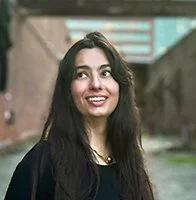
Samantha Correia Pires
Wax Promises
Samantha Correia Pires-Thackara is a Brazilian-American fiction writer and designer based in New Jersey. She writes about otherness, identity, religion, grief, magic, and the built environment.